Simone Martini
Simone Martini (1284-1344) stands as a foundational master of the Sienese Trecento and a pivotal figure in the development of early Italian painting. A native of Siena, his career was defined by a luminous grace that dramatically refined the prevailing Gothic sensibility. His influence extended far beyond Tuscany, making him instrumental in the dissemination of sophisticated courtly aesthetics across Europe.
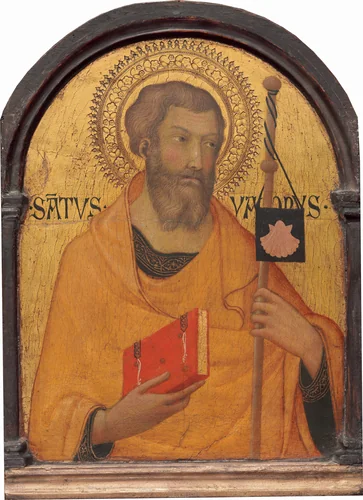
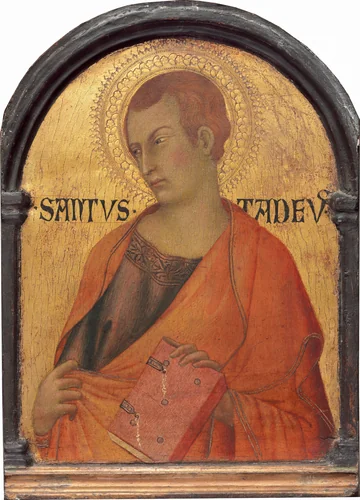
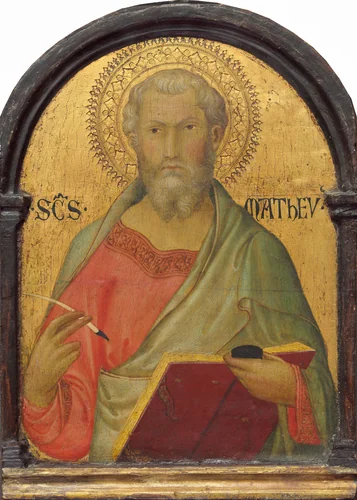
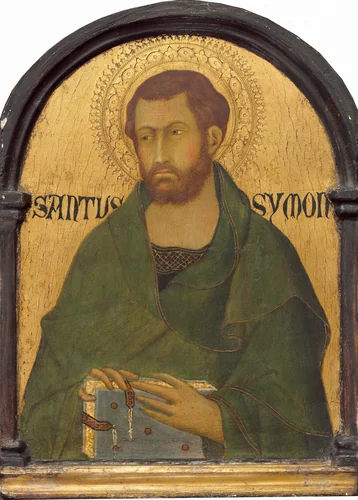
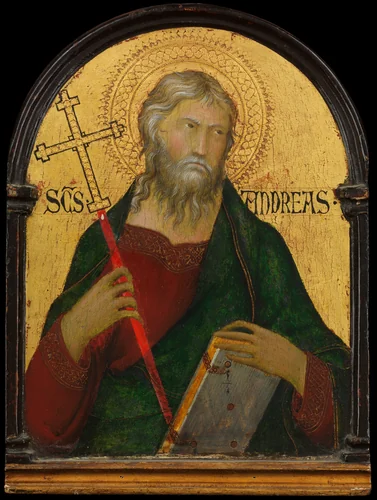
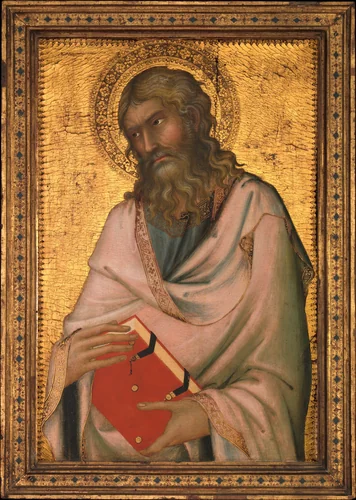
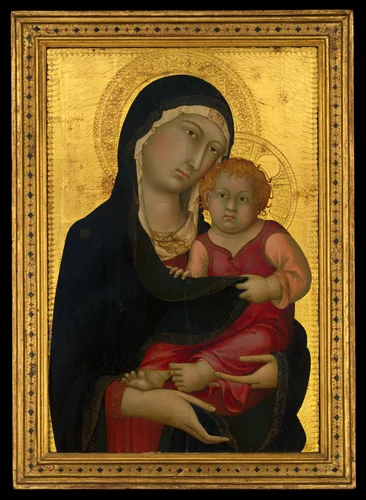
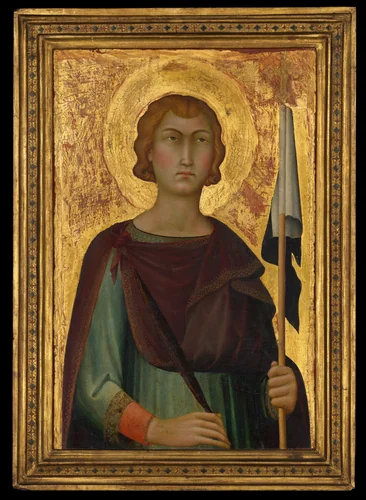
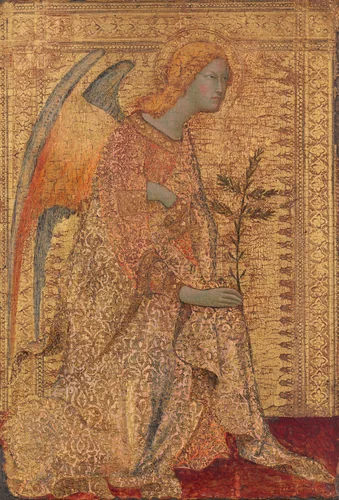
Martini was noted for moving away from the strict conventions of earlier masters, embracing a delicate linear elegance and richly textured surfaces characteristic of the burgeoning Siena School. He was a major force in shaping the pan-European movement that came to be known as International Gothic, synthesizing French courtly grace with the Italian predilection for classical modeling. His innovations lay in his attention to material detail, resulting in a refined palette and meticulous application of gold leaf, granting his religious figures a palpable richness. His surviving panel depictions of saints, including Saint Matthew, Saint Simon, and Saint Andrew, possess an arresting sense of individual presence combined with fluid, naturalistic drapery.
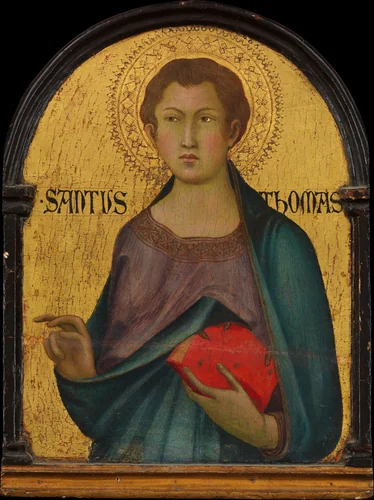
While only eleven paintings are securely attributed to Martini today, his impact was disproportionately large. Unlike some of his contemporaries who focused exclusively on dramatic narrative, Martini perfected the expressive portrayal of holiness, rendering subjects like Saint James Major and Saint Judas Thaddeus with an almost miniaturist precision. It is perhaps a minor tragedy for scholarship that his output was so limited, yet the sheer quality of the surviving Simone Martini paintings assures his continued canonical status.
His short-lived active period, roughly 1315 to 1330, generated a visual grammar that permeated painting for the next century. His celebrated works are preserved in the collections of major institutions worldwide, including the Metropolitan Museum of Art and the National Gallery of Art. Due to their historical significance, many of these masterful compositions are now classified as public domain, enabling the widespread availability of high-quality prints and downloadable artwork for continued study and appreciation.
Source: Wikipedia · CC BY-SA 4.0