Giorgione
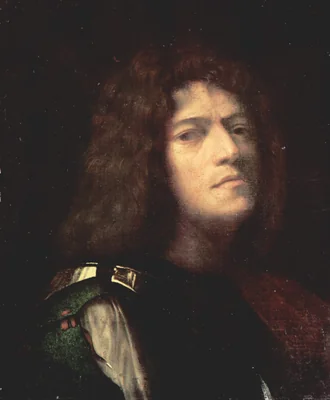
Giorgio Barbarelli da Castelfranco (1477-1510), universally known as Giorgione, stands as one of the most enigmatic yet profoundly influential figures of the Venetian High Renaissance. Despite his tragically brief career, which ended in his early thirties, his innovations fundamentally shifted the trajectory of painting in Venice, moving the emphasis from detailed drawing and narrative clarity towards chromatic intensity and atmospheric effect.
Giorgione is primarily credited with pioneering the pittura tonale style, utilizing subtle gradations of light and shadow to establish mood, a technique that emphasized colorito (coloration) over Florentine disegno (design). This approach resulted in an elusive, poetic quality in his work, characterized by dreamlike landscapes and figures engaged in ambiguous contemplation. This poetic ambiguity has made the attribution and meaning of his sparse oeuvre a lasting challenge for scholars, cementing his status as one of the most mysterious figures in European art history.
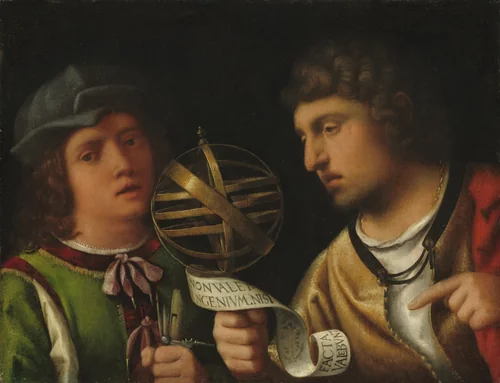
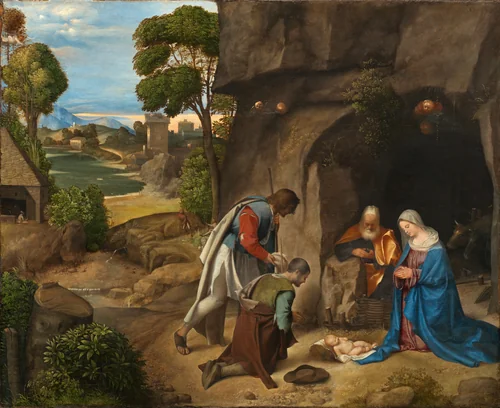
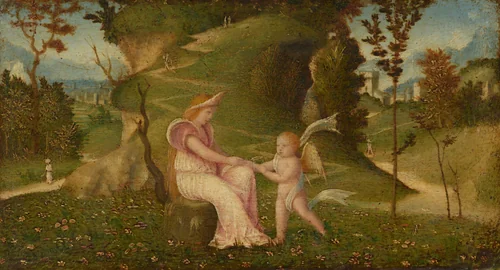
The firm attribution list remains notably small, consisting of only about six surviving Giorgione paintings, yet this handful of works, held in major collections such as the Metropolitan Museum of Art and the National Gallery of Art, holds immense historical weight. Works such as The Adoration of the Shepherds and the mysterious Giovanni Borgherini and His Tutor demonstrate a newfound intimacy and psychological depth previously rare in portraiture and devotional subjects. Perhaps his most famous contribution to the genre of mythological painting is Venus and Cupid in a Landscape, a work that, even if partially completed by Titian, established the standard for subsequent Venetian reclining nudes.
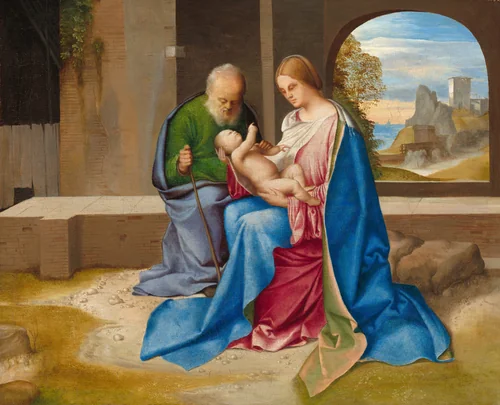
The scarcity of his extant production is partly why Giorgione’s artistic achievements resonated so strongly with his contemporaries, especially the young Titian, who effectively inherited Giorgione’s stylistic mantle. Although the originals are rare, the impact of his innovations is widely accessible. Many of the artist’s known works, including The Holy Family, have entered the public domain and are available today as high-quality prints, allowing for detailed study of his atmospheric genius. Giorgione’s contribution was not merely visual; he introduced a sensibility that defined the emotional tone of Venetian Renaissance art for the generations that followed.
Source: Wikipedia · CC BY-SA 4.0