William Henry Pyne
William Henry Pyne (1769-1843) was a foundational figure in the professionalization of English watercolor painting, recognized during his lifetime as an accomplished writer, illustrator, and painter. His significance is cemented by his role as one of the original co-founders of the Royal Watercolour Society in 1804, an organization that proved crucial in elevating the watercolor medium from a preparatory technique to a finished, display-worthy art form.
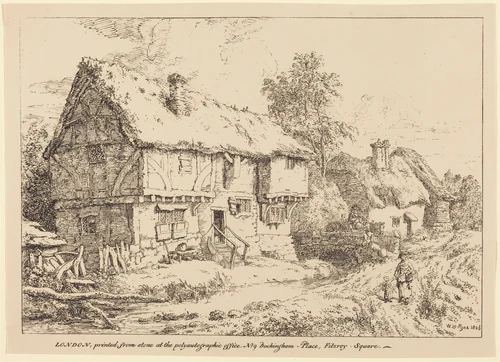
Pyne honed his technical skills at the respected drawing academy of Henry Pars in London. This training led to his first exhibition at the Royal Academy in 1790. Stylistically, Pyne specialized in rendering "picturesque" genre scenes, often centered around lively groups of people engaged in quotidian life, captured primarily through pen, ink, and delicate washes of watercolor. His works are notable for their immediate, observational quality and attention to local color. Pieces such as Figures with Market Goods and the bustling Fishmarket Scene exemplify his focus on the human element within a familiar, working environment.
The intimate nature of his drawings, sometimes utilizing both sides of the paper, as seen in Cattle (recto); The Charlatan (verso), suggests they were intended largely for private collectors or as detailed studies. Pyne excelled at capturing the fleeting interactions of these settings, whether depicting the labor of Feeding Pigs or the dynamic exchange of a street vendor.
Beyond his visual artistry, Pyne maintained a distinct and equally productive literary career, often writing under the pseudonym Ephraim Hardcastle. This suggests an artist who enjoyed engaging with the world through multiple, slightly concealed, identities. While original William Henry Pyne paintings are scarce, his extensive body of drawings and illustrated publications ensures his legacy endures. Today, the immediacy and detailed observational skill captured in these works are increasingly accessible. Many William Henry Pyne prints are now part of the public domain, guaranteeing their continued study and appreciation. The finest examples survive as museum-quality works, available to wider audiences through high-quality prints and downloadable artwork.
Source: Wikipedia · CC BY-SA 4.0