William Henry Jackson
William Henry Jackson (1843-1942) stands as one of the most significant American photographic explorers of the late 19th century. A veteran of the Civil War and a trained painter, Jackson utilized the camera not just as a recording tool but as an instrument of national documentation, visually defining the vast, often unseen territories of the American West. His large-format photographs, created under immensely challenging logistical conditions, supplied the Eastern public and policymakers with the first authoritative views of geological wonders and remote mountainous regions.
Jackson’s most active period, between 1858 and 1879, saw him hauling cumbersome equipment—including heavy glass plates and portable darkrooms—across unforgiving terrain. His involvement in key geological surveys, particularly the Hayden Survey of 1871 and 1872, yielded groundbreaking visual evidence that was instrumental in the U.S. Congress’s decision to establish Yellowstone as the nation's first national park.
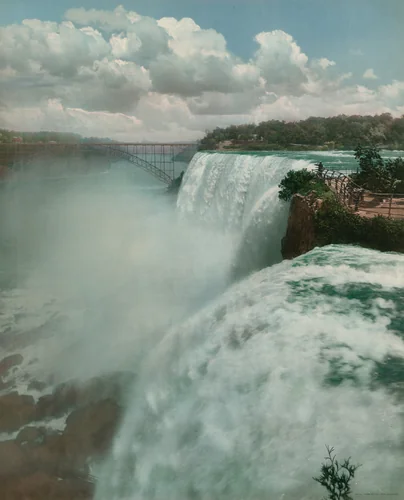
Works such as Fremont's Peak in the Wind River Gorge, Wyoming, Marshall Pass and Mt. Ouray, and the instantly recognizable Balanced Rock, Garden of the Gods exemplify his technical mastery and compositional prowess. These images transcended mere topographic study; they harnessed light and monumental scale to evoke the sublime quality of the American wilderness. Unlike many of his contemporaries, Jackson successfully translated the painter’s eye for form and light into the nascent medium of photography.
The foundational importance of Jackson’s photographic record is reflected in major institutional holdings today, including the Museum of Modern Art, the Art Institute of Chicago, and the National Gallery of Art. Due to the historical nature and widespread dissemination of his expansive archive, a large portion of Jackson's output is categorized as public domain material. Historians and collectors frequently seek out high-quality prints, ensuring that the legacy of Jackson’s monumental visual endeavor—captured on fragile glass plates more than a century ago—remains vividly accessible.
It is perhaps fitting that a man whose visual legacy is tied so intimately to defining America’s physical identity also maintained a surprising link to its cultural iconography; Jackson was the great-great nephew of Samuel Wilson, the man associated with the origin of ‘Uncle Sam.’
Source: Wikipedia · CC BY-SA 4.0