William Havell
William Havell (1788-1831) was a pivotal figure in the early nineteenth-century development of English landscape painting, serving as an important link between topographical drawing and the more atmospheric explorations of the later Romantics. Born into the celebrated Havell family of artists, his immediate significance lay in his institutional work: he was a founding member of the Society of Painters in Watercolours. This crucial move helped legitimize the medium, shifting its status from a preliminary sketching tool to a primary vehicle for finished, exhibition-ready compositions, thereby fundamentally elevating watercolor painting within the British art establishment.
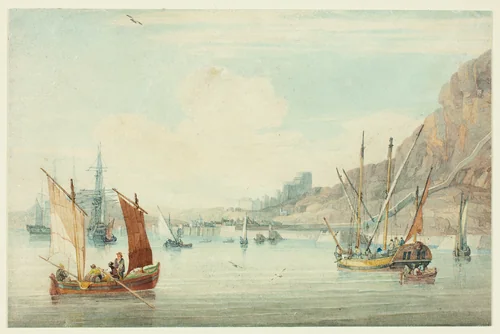
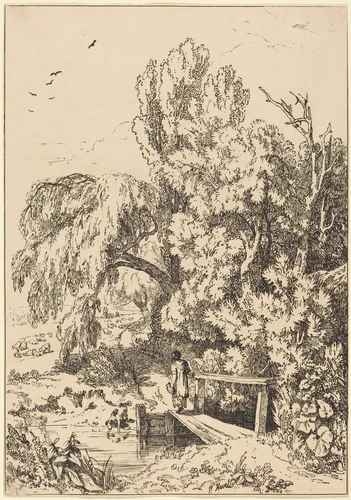
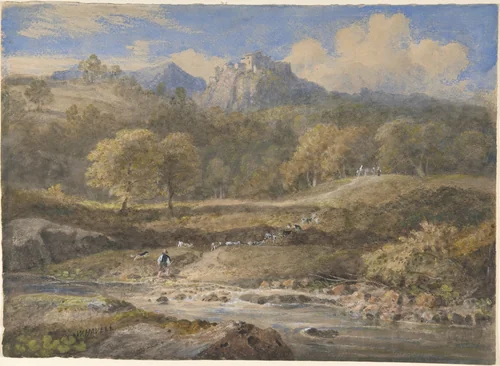
Havell’s works spanned several media, encompassing drawing, etching, and oil painting, though he is generally best recognized for his fluency with watercolor and his resulting print output. His compositions balanced detailed observation, typical of the late eighteenth century, with an increasing interest in capturing the transient effects of light and atmosphere. Works such as View on the Tagus and the delicate study, Landscape with Trees, Girl Crossing Footbridge, demonstrate a commitment to both local English scenes and classical subjects inspired by his travels, exemplified by Licenza, near Rome: Horace's Villa. These diverse landscapes reveal a steady hand in articulating structural forms beneath a highly expressive surface treatment.
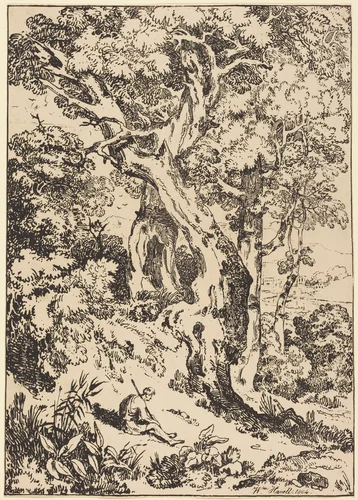
Although his active career was relatively brief, Havell contributed significantly to the visual chronicle of the era, frequently translating his drawings and paintings into popular prints. A subtle indication of his dedication to empirical observation is found in specialized studies like Study of Trees and Shrubs with Seated Figure, which approaches near-botanical accuracy while maintaining compositional harmony. The demand for his output in his own lifetime ensures that many high-quality prints derived from his original designs are available today.
Havell’s technical mastery secured his legacy; he successfully navigated the transition between the strictly architectural landscape tradition and the blossoming Romantic movement. His works are collected by institutions globally, including the Metropolitan Museum of Art, the National Gallery of Art, and the Art Institute of Chicago, securing his position not only as a founding institutional figure but as a consistently important visual chronicler of the early nineteenth century. His contribution to the history of watercolor and printmaking ensures that much of his classic artwork has entered the public domain, making William Havell prints widely accessible for study.
Source: Wikipedia · CC BY-SA 4.0