Willem Romeyn
Willem Romeyn, a figure central to the Dutch Golden Age tradition of Italianate landscape painting, maintained a remarkably consistent visual identity throughout his documented active period, circa 1640 to 1666. Though details of his biography are sparse, his output confirms his position among those northern artists who rendered the idealized light and classical settings of the Mediterranean south. The inclusion of his work in esteemed institutions, including the Rijksmuseum and the Metropolitan Museum of Art, secures his status within the mid-17th century canon.
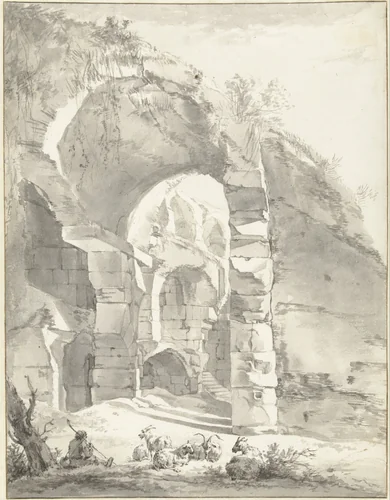
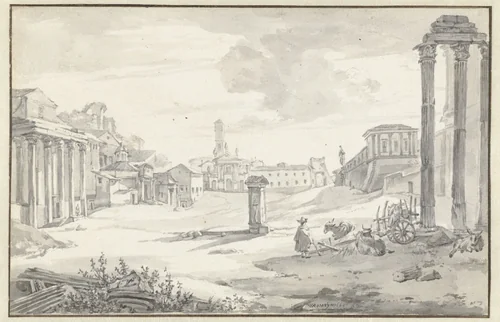
Romeyn's specialization was the veduta, or view, combining natural history and ancient civilization. His compositions often feature low light and warm tonalities, creating a distinctive atmosphere where antiquity and the contemporary co-exist. His characteristic works, such as Roman Ruins with a Shepherd and a Flock of Sheep and Goats, demonstrate his adeptness at integrating architectural fragments, often partially concealed by vegetation, with dynamic human and animal elements.
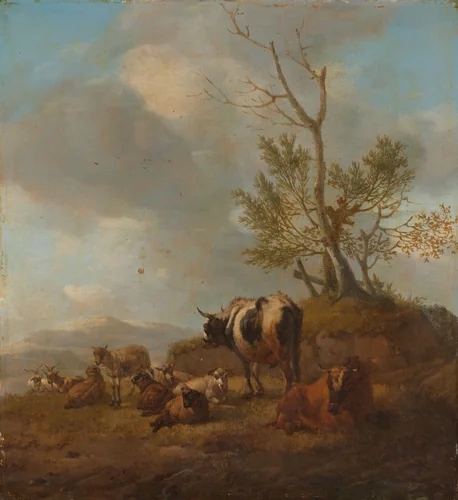
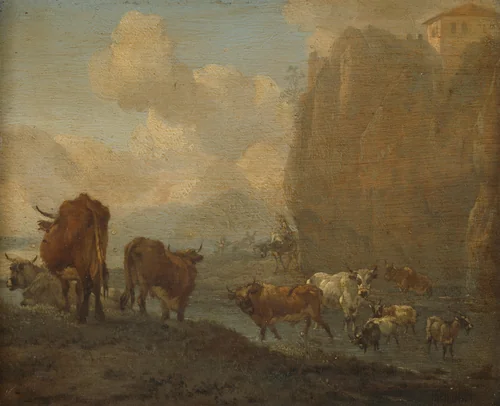
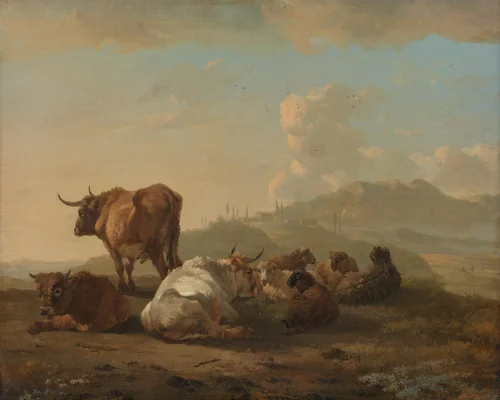
Unlike many of his contemporaries who used animals merely as staffage, Romeyn elevated livestock to a primary structural component of the scene. His careful rendering of goats, cattle, and sheep in works like Livestock by a River or his numerous Pastoral studies suggests a genuine fascination with agrarian life and the textural quality of animal coats. These creatures are never static props; they are essential movers within the narrative, often positioned to guide the viewer’s eye toward the distant vista or the central focal point of the composition. This persistent focus on the precise observation of domesticated species is a signature element distinguishing Willem Romeyn paintings.
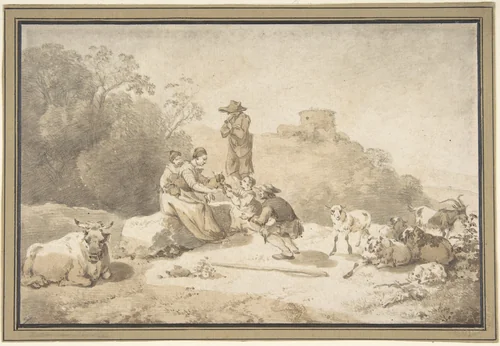
Active both as a painter and a draftsman—three documented drawings accompany his known paintings—Romeyn achieved a sophisticated balance between compositional control and atmospheric spontaneity. While the scope of his entire career is yet to be fully uncovered, his surviving output showcases the mastery required to move beyond simple topographical transcription into poetic landscape interpretation. Scholars continue to examine the subtleties of his technique, and as documentation of his works enters the public domain, the availability of high-quality prints helps ensure his understated, elegant vision continues to be appreciated by a global audience.
Source: Wikipedia · CC BY-SA 4.0