Willem Roelofs
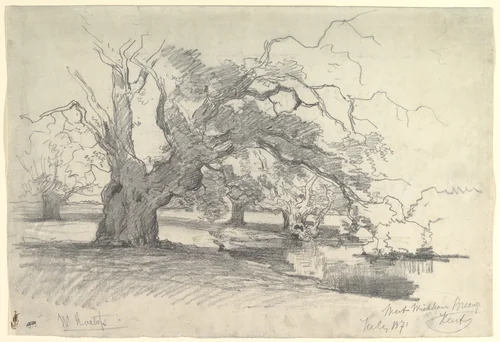
Willem Roelofs occupies a foundational position in the trajectory of 19th-century Dutch painting. As a versatile artist, active across painting, water-colour, etching, lithography, and draughtsmanship, Roelofs was the essential forerunner of the Dutch Revival movement, successfully guiding national aesthetics away from the academic constraints of Romantic Classicism. His influence was critical in establishing The Hague School, providing the stylistic and spiritual impetus that defined a generation of realist landscape painters.
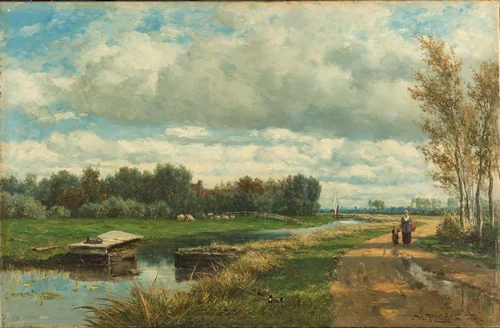
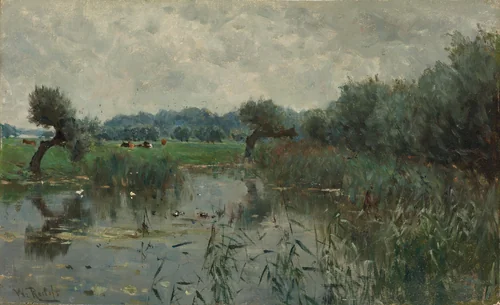
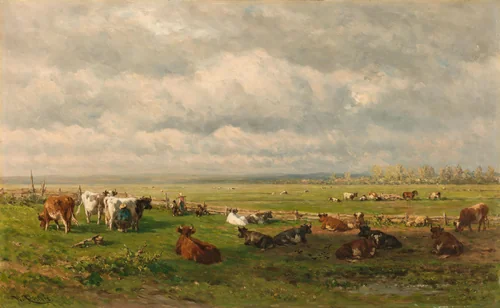
Roelofs achieved this stylistic shift primarily by transporting the naturalism of the French School of Barbizon to the Netherlands. His landscapes are instantly recognizable for their atmospheric depth: compositions typically feature low horizons, dominating cloudy skies, and demure bodies of water often populated with grazing cattle. Works such as Landscape in the Environs of The Hague and Water Meadows on the River IJssel exemplify his focus on the specific topography of the Dutch countryside, capturing light and mood with a remarkable sense of intimacy and tranquility.
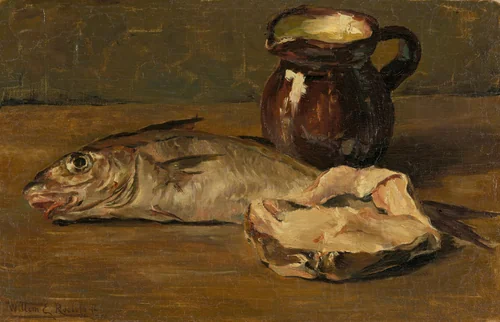
His technical versatility allowed him to explore the same themes across various media, ensuring a widespread stylistic impact. While his enduring reputation rests firmly on these panoramic outdoor studies, Roelofs was not strictly limited to the pastoral. The inclusion of the highly detailed Stilleven met kabeljauw (Still life with codfish) within his collected works provides a charming, if slightly pungent, anomaly in an oeuvre otherwise devoted to open-air observations.
The legacy of Willem Roelofs paintings is secured in collections spanning the globe, including significant holdings at the Rijksmuseum, the Metropolitan Museum of Art, and the Cleveland Museum of Art. His foundational role in shaping Dutch realism has made many of these museum-quality compositions widely accessible. Today, the foundational studies that inspired The Hague School are frequently found in the public domain, making high-quality prints readily available to a new generation of enthusiasts and scholars.
Source: Wikipedia · CC BY-SA 4.0