Willem Maris
Willem Maris (1844-1910) occupies a vital and esteemed position within 19th-century Dutch painting, celebrated as a principal figure of the Hague School. He belonged to the generation of artists who consciously rejected academic convention, seeking instead to revitalize national art by centering on realistic, atmospheric depictions of the local Dutch landscape. Active across a pivotal period in European art, Maris focused his profound technical skill almost exclusively on rendering the light and atmosphere of the polder country.
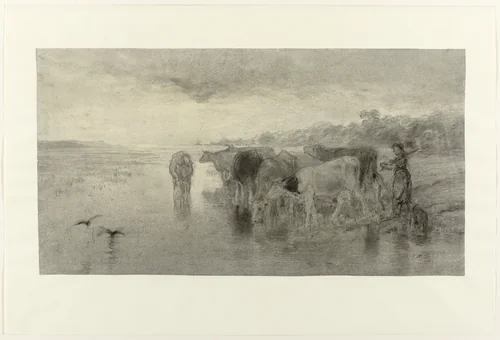
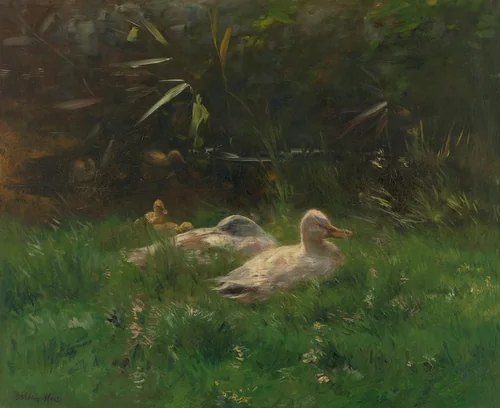
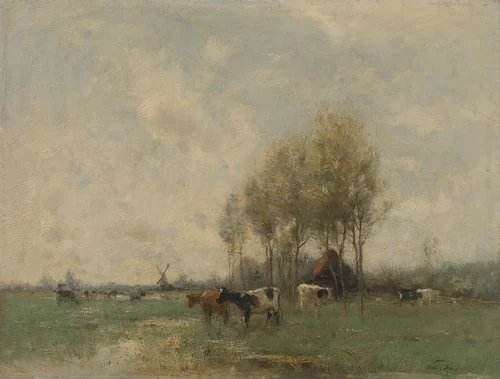
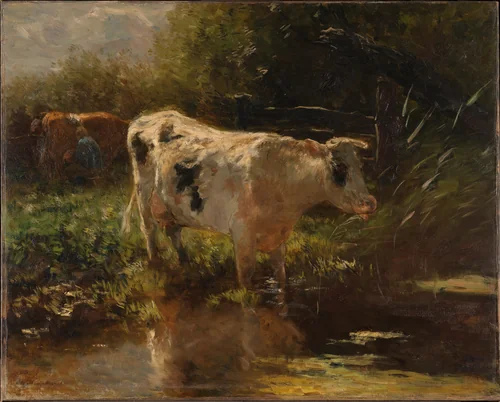
His enduring fame rests upon his specialization in capturing the specific mood of the Dutch environment, particularly its domestic animals. Maris was often characterized as the painter of "sunlight and water," demonstrating a remarkable ability to convey the humidity, dampness, and shifting quality of light over grass and water surfaces. While his contemporaries explored the city and the sea, Maris confined his gaze primarily to cattle and ducks. This narrow focus allowed for an exceptional depth of observation and innovation in technique.
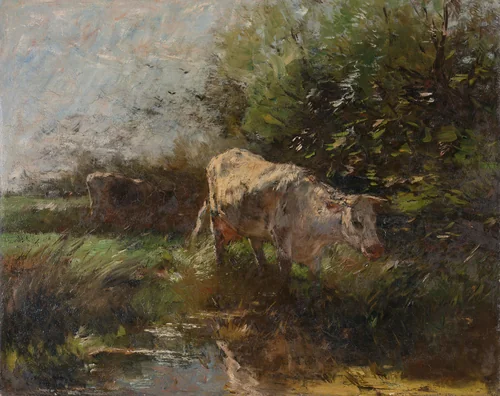
Maris’s style underwent a significant evolution. His early works displayed the meticulous detail characteristic of established Dutch realism, but later in his career, he developed a broader, looser handling. He employed a rich impasto and rapid, visible brushstrokes to suggest rather than define form, thereby emphasizing the transient effects of light and air. This mature approach is evident in compositions like Eenden (Ducks) and the emotionally resonant Zonsondergang (Sunset).
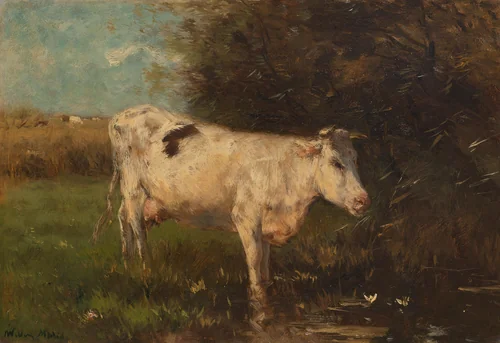
His dedication to this singular subject matter resulted in a sophisticated catalog of rural life. Pieces such as Meadow with Cows, Weide met koeien, and White Cow are masterful studies in texture and luminosity. His compositions frequently showcase a profound serenity, confirming that the most successful artists are often those who remain deeply specialized. It is perhaps an amusing observation that Maris found more distinct pictorial drama in the placement of a cow’s shadow than many of his peers found in historical battle scenes.
The influence of Willem Maris paintings remains strong, with key works housed in collections such as the Rijksmuseum. These museum-quality pieces anchor his legacy as a master of atmosphere. Today, many of his important works are in the public domain, ensuring that students, scholars, and collectors globally can access high-quality prints and downloadable artwork for free art prints, continuing the appreciation of his contribution to Dutch realism.
Source: Wikipedia · CC BY-SA 4.0