Will Dyson
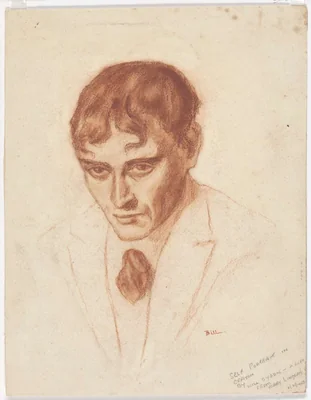
William Henry ('Will') Dyson (1880-1938) was an internationally recognized Australian artist, illustrator, and political cartoonist whose sharp artistic output defined commentary on early 20th-century social and political change. Beginning his professional career in Australia, he quickly established a specialty in caricature, contributing notably to The Bulletin magazine. This early period honed the critical precision and potent visual impact that would characterize his mature work.
In 1909, following his marriage to fellow artist Ruby Lindsay, Dyson relocated to London. His tenure as the primary cartoonist for The Daily Herald newspaper cemented his reputation as a leading illustrator and progressive social commentator in Britain. Dyson’s visual arguments championed reform, tackling difficult subjects such as economic inequality, poverty, and war. His cartoons were not merely illustrations; they were controversial public interventions defined by their extraordinary artistic rigor and biting wit. His ability to distill complex social injustices into a single, compelling image made him one of the most forceful graphic voices of his era.
With the outbreak of the First World War, Dyson redirected his incisive critiques towards German militarism. Recognizing the necessity of documenting the conflict with artistic depth, he applied to join the Australian forces on the Western Front in 1916. Appointed an honorary lieutenant, he joined the Anzac troops in France in January 1917, and by May was formalized as Australia’s first official war artist. This critical appointment ensured that the intensity of the conflict was recorded not just historically, but artistically through the eyes of a master draftsman. Following the sudden death of his wife in March 1919, Dyson experienced a period of profound emotional difficulty that constrained his artistic production. He briefly returned to Melbourne in 1924 under contract with the Herald publishing group before returning permanently to England in 1930.
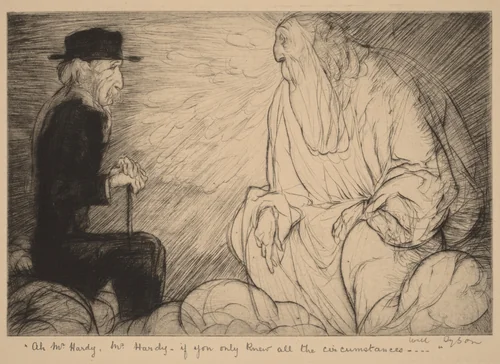
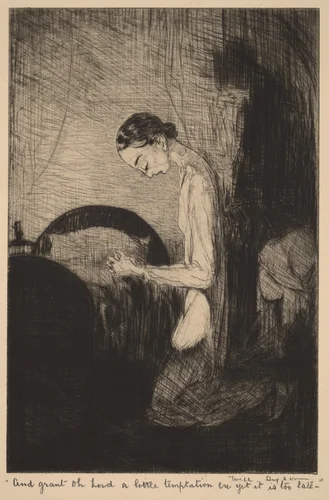
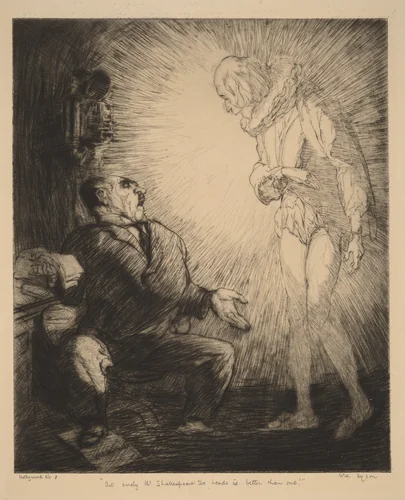
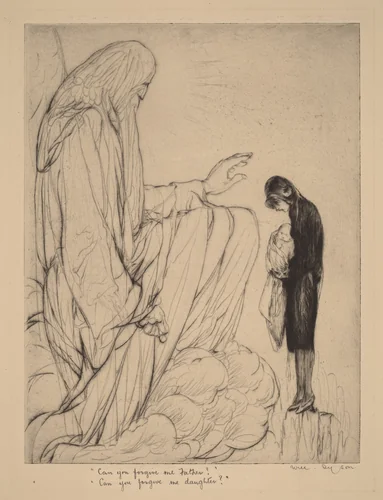
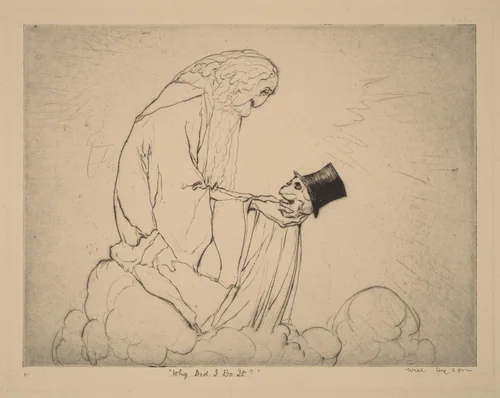
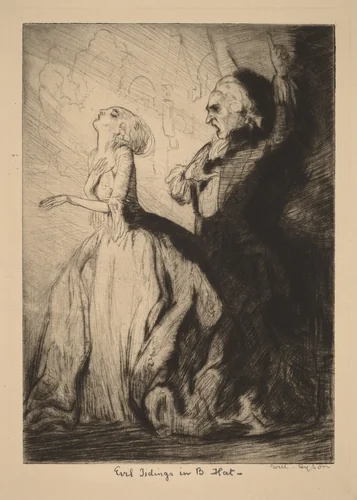
Dyson’s legacy rests on his unwavering commitment to visual commentary and his pioneering role in official war art. While often overlooked today, the power of his compositions, such as those titled "Ah Mr. Hardy, Mr. Hardy, if you only knew all the circumstances..." and "Why Did I Do It?", demonstrates his mastery of narrative illustration. A substantial body of his graphic work is now in the public domain, making high-quality prints readily available for study and appreciation in both private and museum-quality collections.
Source: Wikipedia · CC BY-SA 4.0