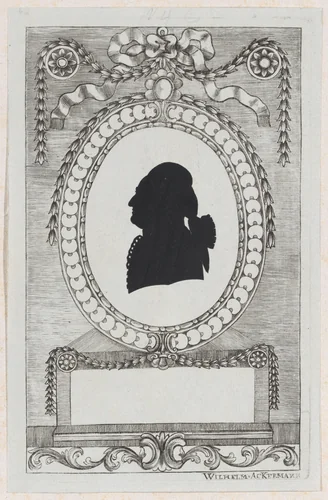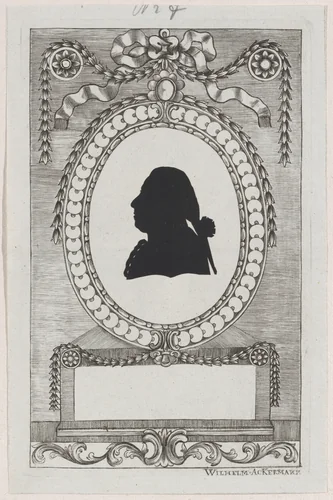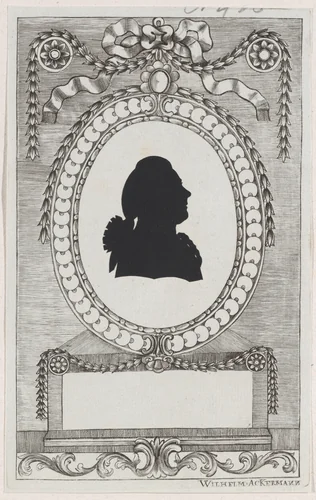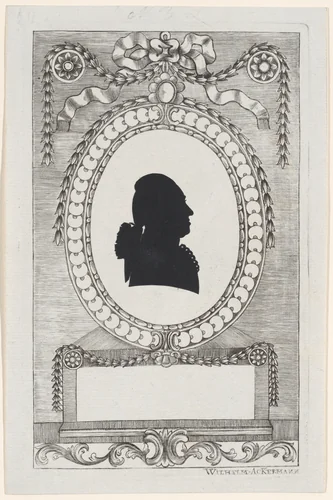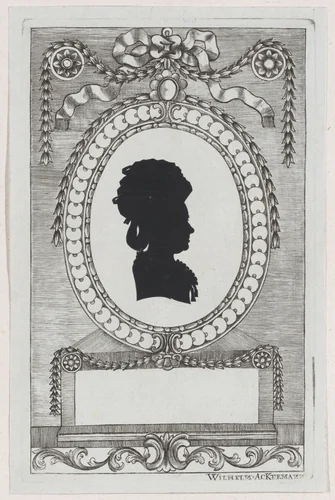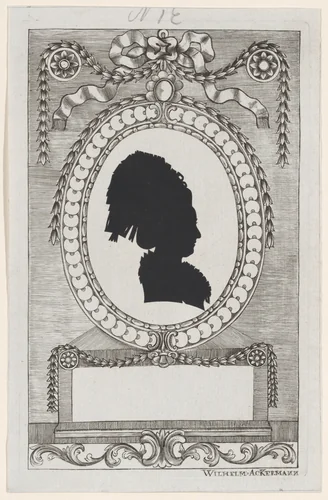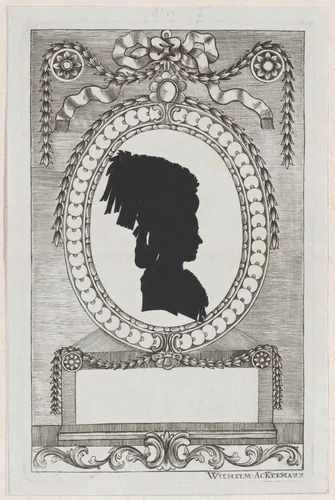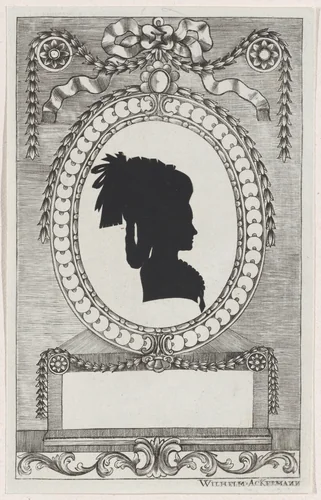
Wilhelm Ackermann
Wilhelm Friedrich Ackermann occupies an unusual, dual position in intellectual history. While often cited for his profound contributions to mathematical logic and the theory of computation—most notably the foundational Ackermann function—his rigorous analytical mind also produced a brief but compelling body of work in the visual arts.
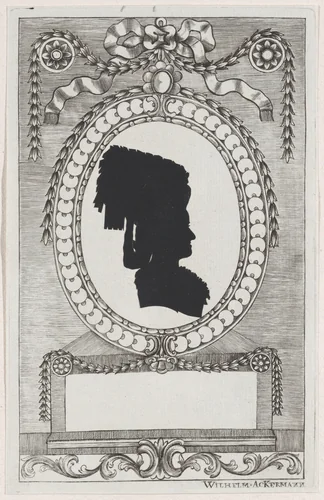
Active in the 1780s, Ackermann established himself through the technically demanding medium of the paper silhouette. This refined form of portraiture, which flourished in the late 18th century, required absolute mastery of line, profile, and negative space, a visual precision perhaps predictable given the artist’s concurrent preoccupation with axiomatic systems. His output, concentrated primarily around 1784, serves as a delicate, precise documentation of European aristocratic society.
The surviving catalogue of his graphic work is small yet highly valued, focusing almost exclusively on high-ranking German and Austrian nobility. Works such as Silhouette of Graf Coreth, Silhouette of Graf Ferrari, and Silhouette of Graf Leopold Kinigl are exemplary demonstrations of how much character and social standing could be conveyed through the stark contrast of cut paper. These works function not merely as portraits, but as miniature sociological studies, capturing the rigid social geometry of the late Enlightenment courts.
The intense focus and lack of embellishment required for a perfect profile offers a fascinating visual parallel to Ackermann’s theoretical pursuits. It is perhaps no coincidence that a master of infinite recursion would apply his exacting mind to the finite, calculated boundary of a profile.
Today, Ackermann’s compositions are preserved in world-class collections, including the Metropolitan Museum of Art. While the historical record features only Wilhelm Ackermann prints rather than paintings, their historical and artistic value remains significant. Interest in these museum-quality documents endures, and many of these 18th-century graphic works are now available as downloadable artwork, allowing scholars and enthusiasts access to these fascinating profiles through high-quality prints in the public domain.
Source: Wikipedia · CC BY-SA 4.0