Wayne Miller
Wayne F. Miller (1918-2013) established the foundation for his distinguished career in photojournalism through a remarkably focused period documenting the American naval effort during World War II. Serving as a Lieutenant and photographer for the U.S. Navy between 1942 and 1945, Miller produced a compelling portfolio of images that captures both the scale of military mobilization and the intimate psychology of service personnel awaiting deployment. This early work, comprising 15 known photographs held in collections such as the National Gallery of Art, demonstrates an immediate mastery of narrative composition.
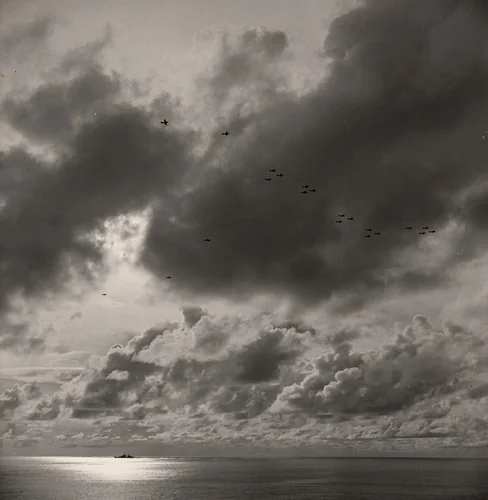
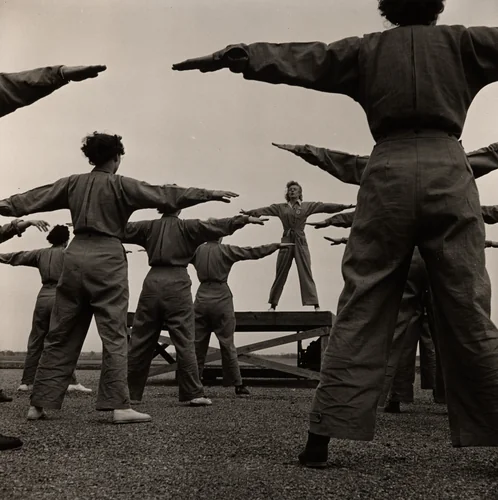
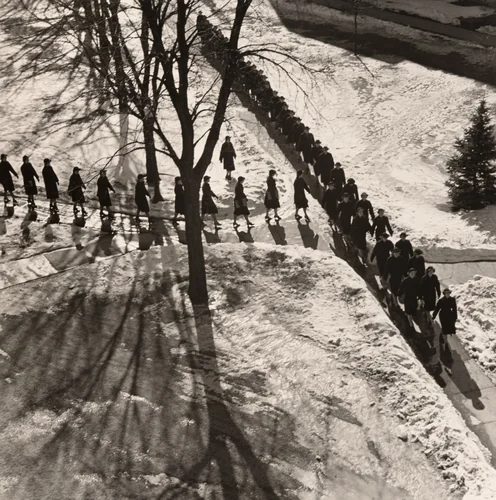
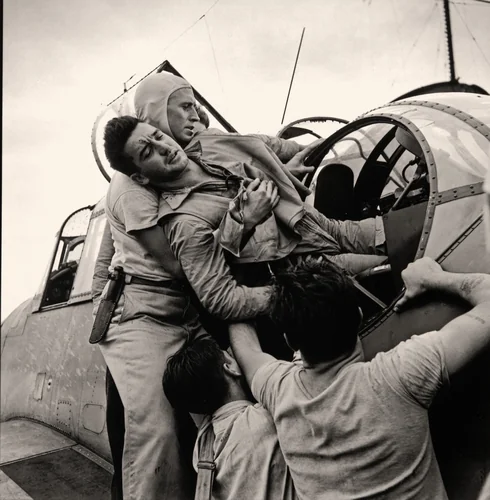
Miller’s technical proficiency allowed him to shift fluidly between grand-scale logistics and observational portraits. Photographs like Carrier Fighters Precede Dive-Bombers in Takeoff to Circle Protectively above the Carrier exhibit the clean, functional aesthetic required for military documentation, emphasizing movement and technical coordination. Conversely, his eye for the human element emerged in scenes of training and routine at facilities across the nation, from the Naval Air Technical Training Center in Norman, Oklahoma, to the U.S. Naval Training Center, Women's Reserve in Cedar Falls, Iowa.
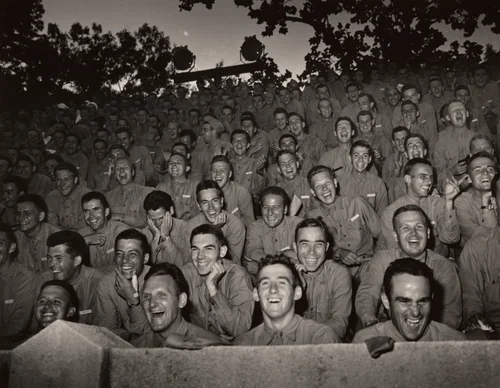
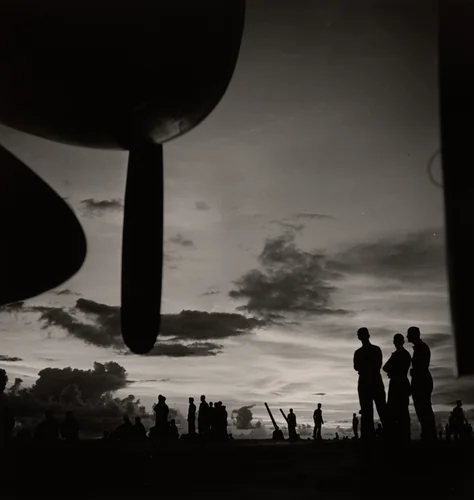
His most evocative images often occur during moments of transition. In Sunset on the USS Saratoga, Watching for Japanese Kamikazes, Miller transforms a high-stress scenario into a deeply atmospheric silhouette, capturing the tense stillness inherent in naval readiness. A subtle personality element woven through his documentation of early training, such as the future aviators shown in Pre-flight School, Future Naval Aviators Watching a Show, Chapel Hill, North Carolina, is his acute awareness of the brief, perhaps fleeting, pauses of leisure afforded to subjects before they confront the rigors of combat.
These images are foundational to the study of 20th-century photojournalism. Given their historical importance, many of these classic Wayne Miller prints are accessible through public domain archives, allowing researchers and collectors to obtain high-quality prints for personal or institutional study. This initial body of work provided Miller with the disciplined approach and observational acuity he would carry forward into his later, critically acclaimed projects and his tenure with Magnum Photos.