Wang Yuanqi
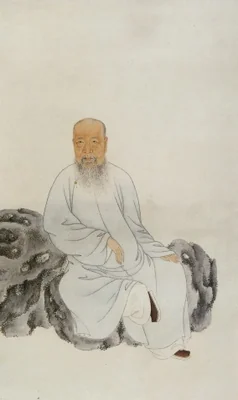
Wang Yuanqi (1642-1711) stands as the last and perhaps most intellectually rigorous member of the 'Four Wangs,' the influential cohort whose classical methodology dominated artistic practice and defined court taste during the early Qing dynasty. Serving as both a painter and a highly placed court official, Wang exerted immense influence, ensuring his orthodox approach to traditional Chinese painting remained the prevailing aesthetic standard for decades. His active period bridged the consolidation of Manchu rule, a time when defining national artistic identity became a priority.
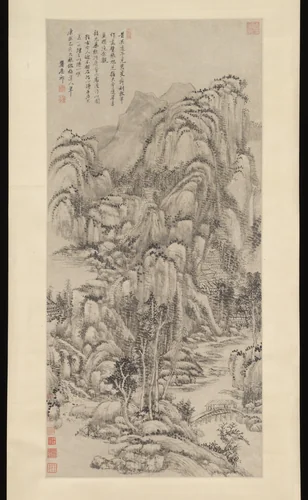
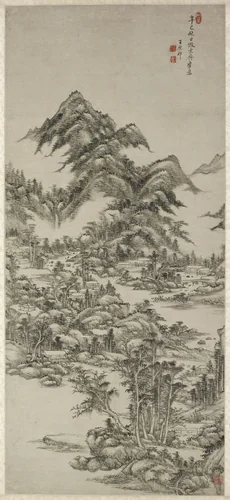
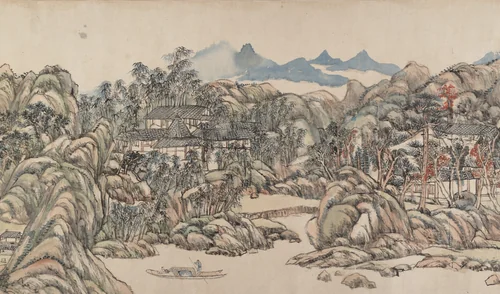
Unlike some of his contemporaries who might stray toward expressive freedom, Wang dedicated his career to the rigorous academic study of historical precedents, particularly the structural masters of the Yuan dynasty. He was notably devoted to the work of Huang Gongwang, whose compositions he did not merely copy, but systematically dissected and reassembled. This approach resulted in Wang Yuanqi paintings that are characterized less by descriptive naturalism than by complex, layered structures built through meticulous, dry brushwork (cun).
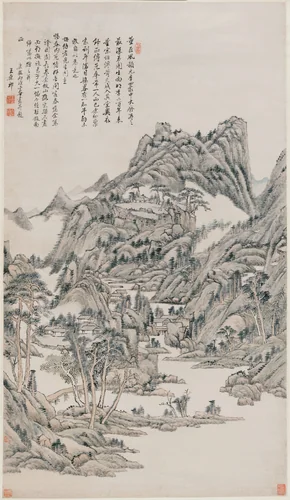
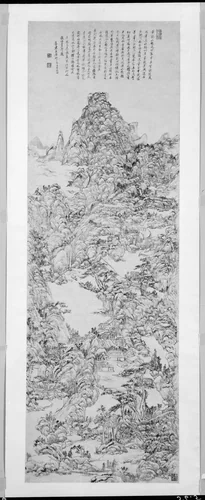
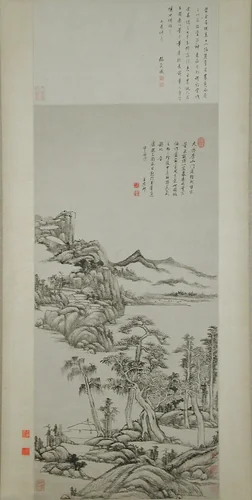
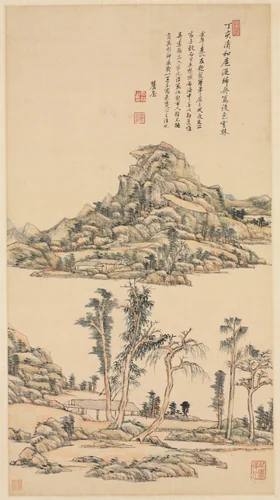
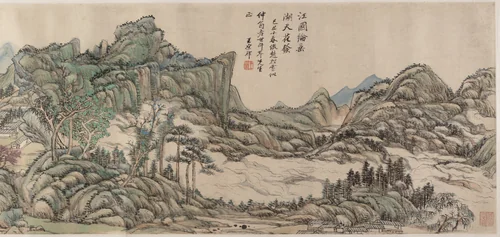
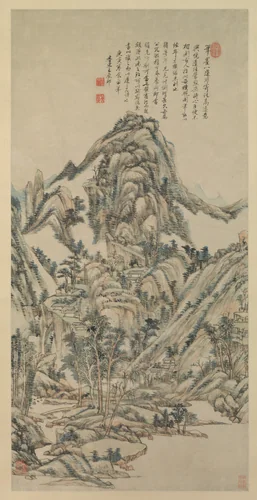
His works, such as Landscape after Wu Zhen and the structurally powerful Green Peaks under Clear Sky: After Huang Gongwang, reveal a painter absorbed with the technical problems of conveying geological mass and atmospheric perspective. His compositions often appear highly architectural, as if he were constructing geological models rather than depicting specific scenery. It is perhaps characteristic of Wang’s cerebral approach that even when creating a piece after an ancient master, the resulting work feels filtered entirely through his own systematic understanding of spatial dynamics and tradition.
Wang’s enduring art historical significance is attested to by the presence of his major works in prestigious Western institutions, including the Metropolitan Museum of Art, the Art Institute of Chicago, and the Cleveland Museum of Art. These museum-quality examples of Qing orthodoxy confirm his status as a master academician. The continued study of his achievements, often via high-quality prints derived from public collections, ensures that the structural lessons imparted by this seminal figure remain accessible to scholars and artists worldwide.
Source: Wikipedia · CC BY-SA 4.0