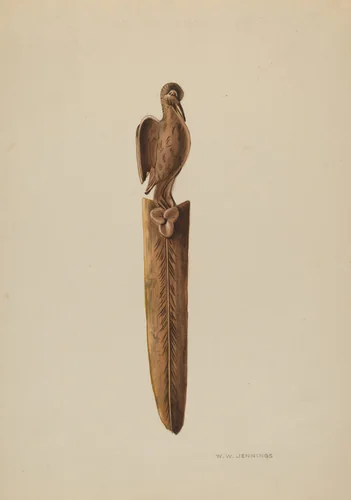
Walter Jennings
Walter Jennings, active primarily between 1930 and 1936, holds a significant, if often understated, position within the history of American documentary art. While the name ‘Walter Jennings’ is associated with various public figures, the artist whose meticulous renderings grace the Index of American Design (IAD) represents a crucial visual chronicler of Depression-era material culture. His efforts were part of the ambitious federal initiative designed not only to provide employment for artists but also to create a comprehensive pictorial record of the nation’s decorative and folk arts, capturing objects before they disappeared or deteriorated.
Jennings contributed 15 works to the Index, focusing on items of domestic utility and historical craft. His detailed watercolors and sketches illustrate the high standards of craftsmanship inherent in early American objects. Works such as Grandfather's Clock and Chest reveal an anthropological approach, prioritizing structural accuracy and material texture over artistic flourish. Yet, even in his documentation of smaller items, like the delicate precision required for Earrings or the pattern study of Lace Trim, Jennings demonstrated an undeniable commitment to museum-quality representation. The inclusion of an item as quaintly specific as a Doll Carriage offers a subtle observation on the enduring value placed on detailed historical domestic life.
The lasting impact of Jennings’ six years of focused activity is the historical fidelity embedded in these records. The IAD collection, now housed within the prestigious holdings of the National Gallery of Art, Washington D.C., ensures that these unique object studies remain accessible for historians, researchers, and designers. Due to the nature of the federal project, the documentation created by Jennings and his contemporaries is now largely in the public domain. This fact makes the meticulous drawings, essentially the original Walter Jennings prints and design studies, highly valuable source material. Enthusiasts and researchers can find downloadable artwork and high-quality reproductions, demonstrating that the WPA’s commitment to visual preservation continues to benefit contemporary study, long after the need for the original government stimulus ended.
Source: Wikipedia · CC BY-SA 4.0