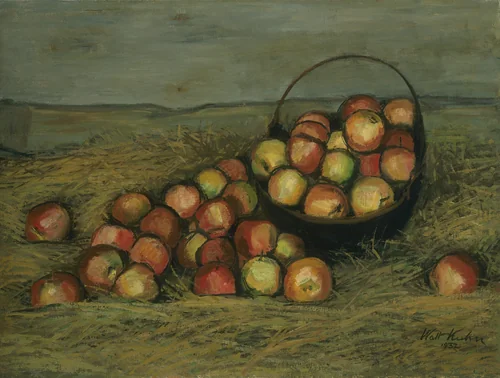
Walt Kuhn
Walter Francis Kuhn (1877-1949) occupies a foundational position in the development of American art, recognized internationally not merely for his distinct painting output but primarily as the driving force and chief organizer of the 1913 International Exhibition of Modern Art. Famously known as the Armory Show, this groundbreaking exhibition served as America’s first large-scale, unfiltered introduction to European Modernism. By bringing revolutionary works by Cézanne, Van Gogh, and Picasso to American soil, Kuhn’s relentless energy and commitment fundamentally redefined the trajectory of American taste, collecting, and artistic practice.
While renowned as an impresario, Kuhn was an accomplished figurative artist who worked prolifically across painting, drawing, and various print media. His studio practice centered heavily on capturing powerful, isolated character studies, particularly subjects drawn from the worlds of vaudeville, circuses, and the stage. His goal was often to strip away the performance and reveal an essential emotional vulnerability.
This focused, sculptural approach is evident in his graphic works, such as the intimate lithograph Bust of Sophie, and the robust figure study Strong Girl. Kuhn possessed a keen ability to use sharp compositional elements and simplified backgrounds, forcing the viewer to confront the sitter directly, whether observing the quiet concentration captured in Dressing or the athletic posture rendered in Girl in Knickerbockers. His dedication to character study resulted in some of the most compelling American figures painted in the first half of the twentieth century.
The period spanning 1895 to 1922 saw significant output in drawing and the creation of essential early Walt Kuhn prints. Today, his works are held in major institutional collections, including the Museum of Modern Art (MoMA) and the Cleveland Museum of Art. His enduring historical importance ensures that many of his high-quality prints and related graphic studies are now available in the public domain. It remains one of art history’s subtle ironies that the man responsible for unleashing the chaotic freedom of European Modernism upon America was himself a master of such tightly controlled, formally rigorous portraiture.