Vivant Denon
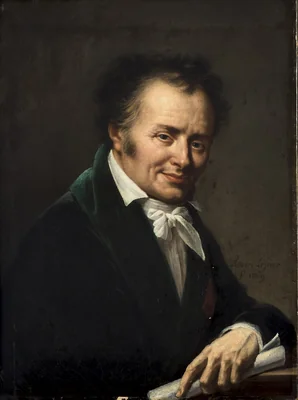
Dominique Vivant, Baron Denon (1747-1820), stands as a unique figure of the French Enlightenment and Napoleonic eras, seamlessly navigating the worlds of art creation, diplomacy, and monumental institutional administration. Originally educated as an artist, he transitioned early in his career into diplomatic service, holding posts under Louis XV and Louis XVI, yet his deep-seated artistic inclination remained central to his life’s work.
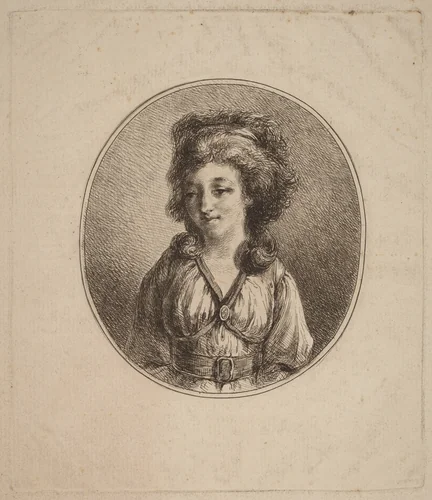
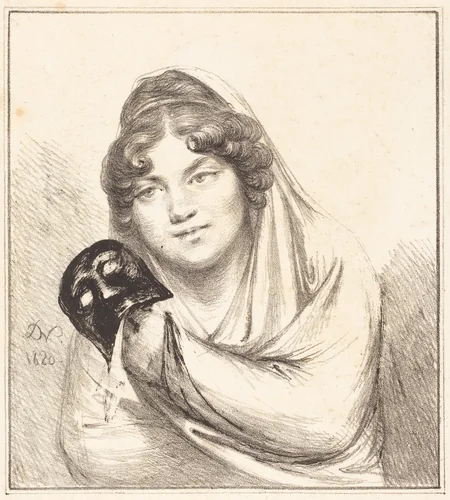
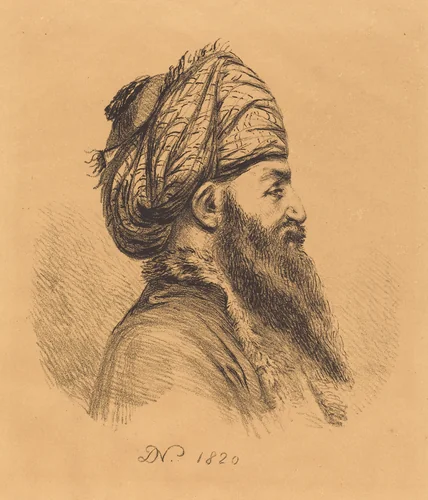
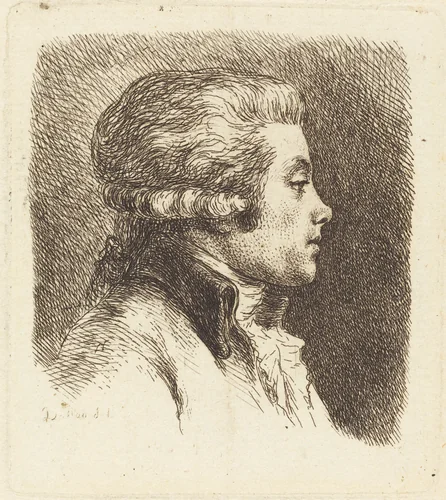
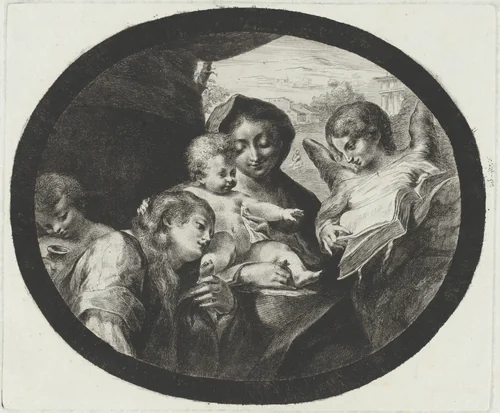
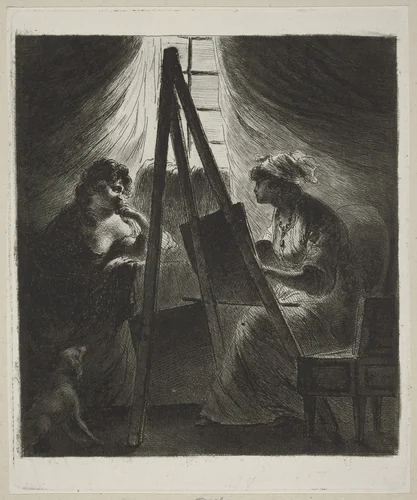
Denon excelled particularly in the media of drawing and etching, which provided the immediacy necessary for documenting the complex political and social fluctuations of his time. His prolific output of Vivant Denon prints and etchings, alongside drawings such as A Young Woman Sewing [recto], reflects the neoclassical precision of the late eighteenth century while capturing both intimate domesticity and professional commerce. Other key works, like the print Citizen Aubour, Print Publisher, document the emerging culture of mass reproduction. These records of daily life and history, held in collections such as the National Gallery of Art, remain valuable examples of high-quality prints from the period, many of which are now available in the public domain for scholarly study.
Denon’s trajectory pivoted dramatically when he accompanied Napoleon Bonaparte’s 1798 military campaign into Egypt as the expedition’s official artist-correspondent. This experience resulted in invaluable fieldwork and the subsequent creation of Voyage dans la basse et la haute Egypte (1802). Celebrated for its detailed, precise illustrations and descriptive rigor, this two-volume masterpiece was fundamental in establishing modern Egyptology as a discipline.
Upon returning to Paris, Denon was immediately appointed by Napoleon as the first director of the Musée Central des Arts, the institution which later became the Louvre Museum. His tenure shaped the organizational structure, cataloging methods, and acquisition policies of the modern encyclopedic museum. It is perhaps the most fascinating irony of his legacy that a man who helped define the study of ancient pharaohs also had the foresight to define the structure of the world’s largest art repository. Denon’s crucial influence is permanently commemorated in the Denon Wing of the Louvre and the Dominique-Vivant Denon Research Center, honoring the artist who became the architect of museum-quality curation.
Source: Wikipedia · CC BY-SA 4.0
![A Horseman Wearing a Grande Cockade [verso] by Vivant Denon, drawing, 1790](https://img.artbee.org/f1a9250b-bdf2-4a3f-b057-de997ad958ba/small.webp)
![A Young Woman Sewing [recto] by Vivant Denon, drawing, 1790](https://img.artbee.org/ca49d157-4083-4454-b61f-1c3b2c9ca622/small.webp)