Victor Hugo
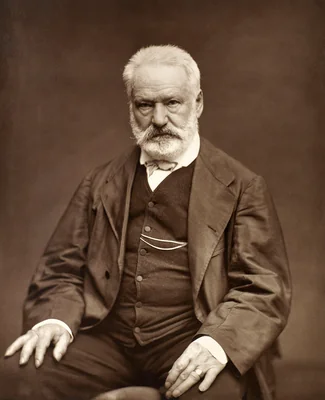
Victor-Marie Hugo (1802-1885), widely celebrated as the definitive figure of French Romantic literature, sustained an equally serious, though often overlooked, parallel career as a visual artist. Active primarily in drawing and printmaking between 1850 and 1877, Hugo’s artwork serves not as mere illustration of his written work but as an independent, intensely dramatic exploration of the sublime and the grotesque. This visual output, created largely during his decades of political exile, reveals a distinct mastery of atmospheric tension and symbolic iconography.
Hugo’s drawings employ strong contrasts and deep shadow, favoring ink washes, pen, and often accidental media to achieve a powerful, melancholic effect. His approach was deliberately experimental; he was known to incorporate coffee stains, fingerprints, or burnt matches directly into his compositions, transforming standard graphic techniques into highly personalized statements. This restless artistic impulse resulted in works that communicate an internal psychological state more than an external reality.
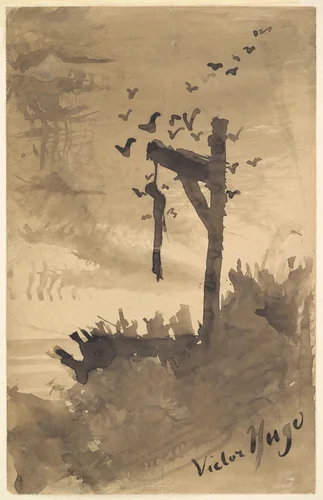
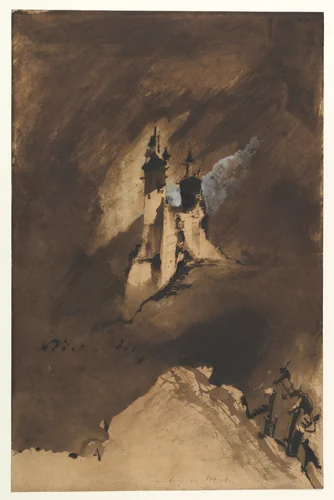
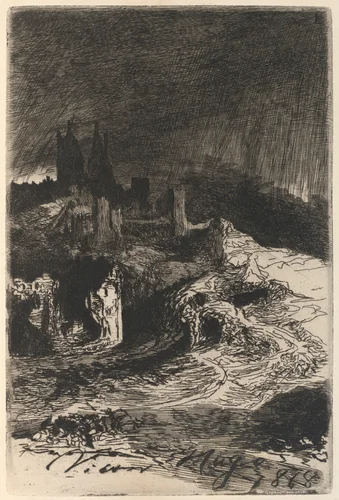
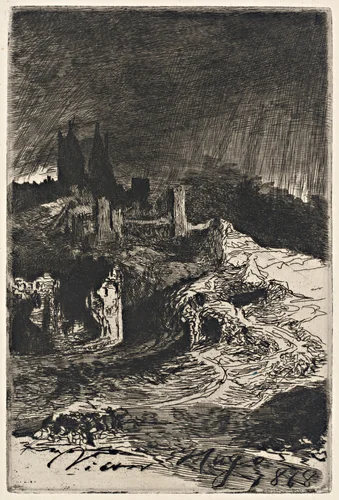
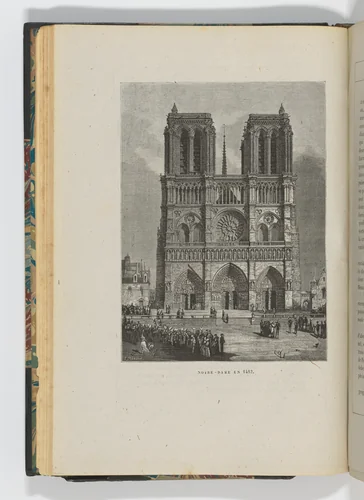
The visual portfolio often leaned into gothic and architectural subjects. Works such as The Hanged Man utilize exaggerated perspective and impenetrable darkness to convey existential drama, a visual corollary to the emotional depth of his literary prose. Conversely, pieces like Souvenir of a Castle in Vosges demonstrate his ability to render nuanced, if brooding, architectural nostalgia. His lifelong fascination with the decay and grandeur of medieval structures, famously articulated in his novel Nôtre Dame de Paris, provided fertile ground for numerous architectural sketches and studies. The raw, expressionistic energy found in L'Eclair (Lightning) illustrates his command over capturing transient, powerful natural phenomena.
While Hugo was a politician, poet, essayist, and human rights activist, his commitment to the graphic arts was constant. He rarely exhibited the works during his lifetime, treating them as a private necessity rather than a public pursuit. This lends a powerful intimacy to the surviving collection. Today, these seminal drawings and Victor Hugo prints are preserved in major repositories including the Metropolitan Museum of Art and the National Gallery of Art, confirming their museum-quality historical significance. Many of these profound and evocative works have entered the public domain, ensuring that this crucial dimension of Hugo’s creative genius remains accessible worldwide.
Source: Wikipedia · CC BY-SA 4.0