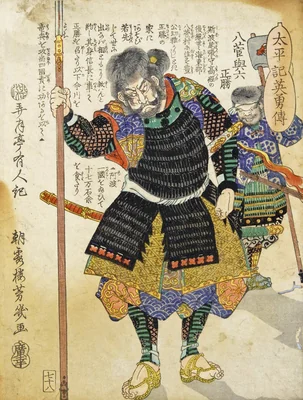
Utagawa Yoshiiku
Utagawa Yoshiiku (Ochiai Yoshiiku), a significant figure within the late period of Japanese ukiyo-e, stands as a principal artist of the powerful Utagawa school. Emerging during a period defined by dramatic social and political shifts, Yoshiiku contributed robustly to the tradition of woodblock printing active across the period defined by the database scope (1615-1861). While the Utagawa lineage is renowned for its sheer productivity, Yoshiiku carved out a specialized niche through his dramatic flair and mastery of figurative expression.
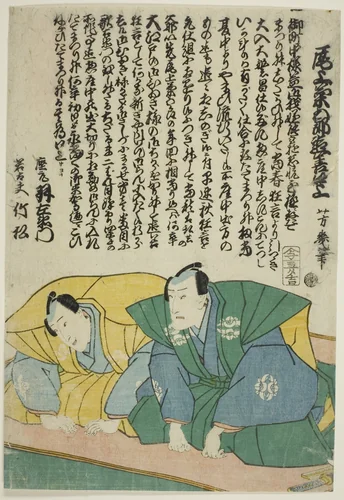
His output demonstrates a keen engagement with the popular theatre and folklore of the Edo and early Meiji eras. A substantial portion of his extant work focuses on yakusha-e, or portraits of Kabuki actors, often capturing them in moments of intense emotionality or theatrical climax. His approach sometimes deviated from typical, overly detailed portraits, exemplified by his series of Silhouette Image of Kabuki Actor prints. These works, stripped down to essential form and shadow, reveal an artist fascinated by the potential of negative space and the power of graphic reduction to convey character and movement.
This graphic intensity is further evident in his prints dealing with the supernatural, a popular genre in 19th-century Japan. The striking image Toriyama Akinari Terutada with Ghost; (The Lavender Chapter) illustrates his ability to blend narrative complexity with visual drama, cementing his reputation among collectors of musha-e and ghost stories. Yoshiiku possessed a sophisticated understanding of line weight and composition; he could be subtle when depicting elegant courtesans or startlingly bold when illustrating mythological confrontations.
As an artist whose work chronicled a transitional period in Japanese history, Yoshiiku’s legacy is preserved in major international repositories, including the Rijksmuseum and the Metropolitan Museum of Art. The accessibility of his catalog has increased dramatically in recent years; many Utagawa Yoshiiku prints, known for their expressive high-quality, are now available as downloadable artwork, allowing scholars and enthusiasts worldwide access to these museum-quality reproductions. Yoshiiku’s contribution to ukiyo-e was not merely continuation but refinement, ensuring the school retained its authoritative visual voice until the very end of the woodblock print tradition.
Source: Wikipedia · CC BY-SA 4.0