Utagawa Kunisada II
Utagawa Kunisada II (active 1837-1875) occupies a significant and foundational position in the late Edo and early Meiji history of ukiyo-e. He was one of three distinguished designers to inherit and use the influential name "Kunisada," establishing him as the designated leader of the Utagawa school, the dominant force in Japanese printmaking during the mid-nineteenth century.
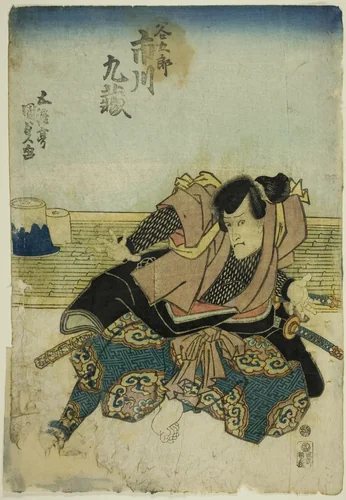
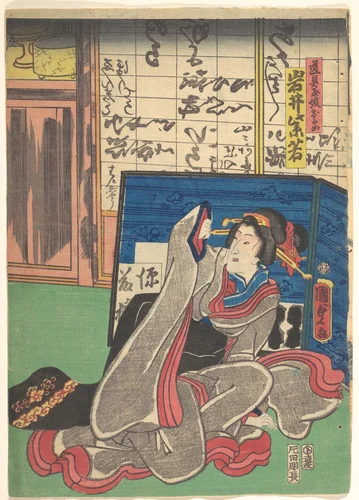
As head of this prolific atelier, Kunisada II extended the traditional thematic boundaries established by his predecessor while subtly incorporating the aesthetic shifts of a rapidly modernizing society. His body of work encompasses the primary genres of the era, notably yakusha-e (actor portraits) and bijinga (pictures of beautiful women), marked by a precise technical execution and an understanding of theatrical drama. Examples such as The actor Ichikawa Kuzo II as Tanigoro and Iwai Shijaku II as Okame, the Daughter of a Furniture Store underscore his mastery of character and costume detail.
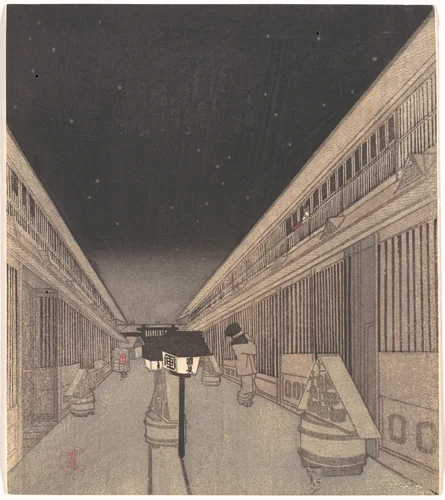
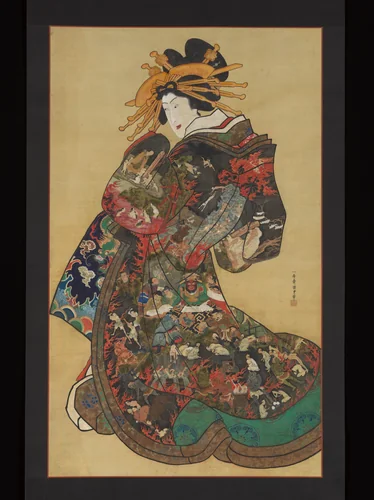
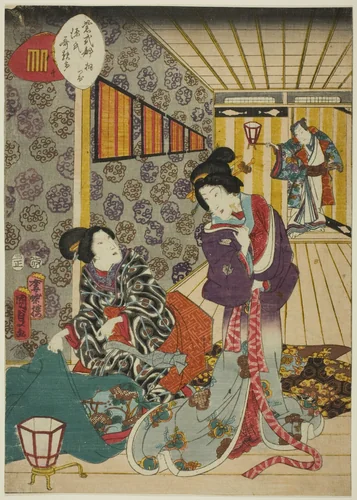
Beyond the conventional portraiture, Kunisada II demonstrated a unique ability to capture atmospheric mood and allegorical depth. His series based on The Tale of Genji remains highly regarded, particularly designs like Kiritsubo, No. 1 from the series "Murasaki Shikibu's Genji Cards (Murasaki Shikibu Genji karuta)", which translates classical literature into contemporary visual language. More dramatically, Main Street of the Yoshiwara on a Starlight Night is less a literal depiction of the pleasure quarter and more an architectural study, where the narrow vista and deep perspective transform the bustling locale into a powerful, almost abstract pattern of light. Likewise, conceptual pieces such as The Hell Courtesan reflect the era's taste for morally complex narratives rendered in vivid color. It is perhaps this blend of the strictly conventional and the surprisingly atmospheric that defines the lasting appeal of Utagawa Kunisada II prints.
His historical importance is affirmed by the inclusion of his work in major institutions globally, including the Metropolitan Museum of Art and the Art Institute of Chicago. Though predominantly known for his output in woodblock, records indicate he also produced Utagawa Kunisada II paintings, demonstrating a versatility across media. Today, many of these historical works are held in the public domain, providing researchers and collectors access to downloadable artwork and high-quality prints for study and appreciation.
Source: Wikipedia · CC BY-SA 4.0