Tsukioka Kogyo
Kōgyo Tsukioka (1869–1927) established himself as the definitive visual chronicler of Japanese Noh theatre during the Meiji period, transforming the formalized stage into durable visual documentation. Although occasionally known by the familial name Sakamaki, his artistic identity is inextricably linked to the intricate and demanding subject of classical Noh drama.
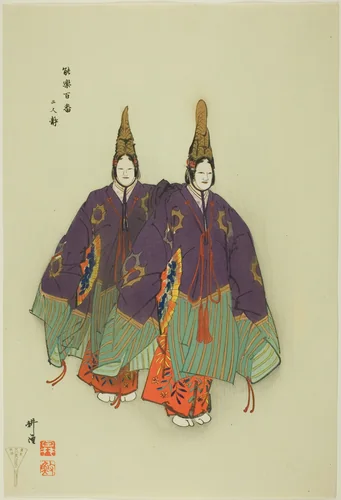
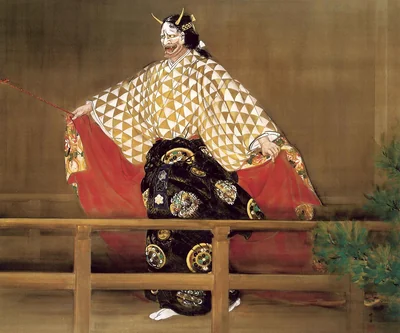
Kogyo’s training provided him with an authoritative lineage; he was the adopted son and student of the great ukiyo-e master Tsukioka Yoshitoshi, and also studied under Ogata Gekkō. This dual mentorship equipped him with both the refined dramatic sensibility of late ukiyo-e and the precise draughtsmanship essential for depicting Noh’s highly ritualized costumes and masks. While Kogyo occasionally engaged with other subjects, such as landscapes, his legacy rests almost entirely on his prodigious output related to the stage, rendered both as large-scale paintings and, crucially, as colored woodblock prints.
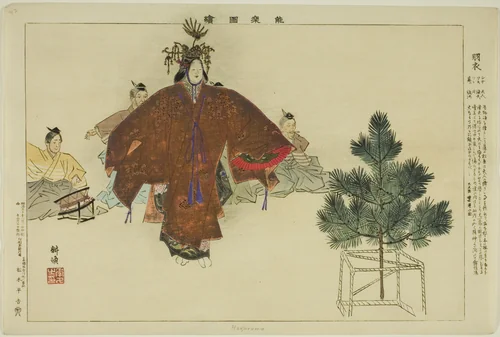
His primary contribution was the creation of extensive, multi-volume print series designed for connoisseurs, scholars, and wealthy patrons interested in preserving the classical arts during an era of rapid modernization. These were not ephemeral single-sheet releases, but systematic projects that aimed for comprehensive coverage of the repertoire. Works such as Nōgaku zue (Pictures of No Performances) and Nōga taikan were issued in sets, often utilizing specialized bindings appropriate for high-end reference material, including the accordion-style orihon and the sewn yamato toji.
The sheer scale of these projects—documenting hundreds of distinct performances and characters—is perhaps Kogyo’s most remarkable achievement, elevating stage imagery to the status of fine art. Unlike earlier, more illustrative treatments, Kogyo focused on the psychological gravity inherent in the plays, captured through his masterful use of color and composition. Today, while complete sets are often guarded as museum-quality institutional holdings in collections such as the Art Institute of Chicago, individual Tsukioka Kogyo prints remain widely accessible through specialist dealers. Furthermore, many of his key works have entered the public domain, allowing institutions to provide high-quality prints and downloadable artwork, ensuring that his unique visual record of Noh continues to inform and inspire contemporary audiences.
Source: Wikipedia · CC BY-SA 4.0