Trenton Doyle Hancock
Trenton Doyle Hancock is a pivotal figure in contemporary American art, whose diverse practice spans high-concept drawing, printmaking, and monumental collaged-felt paintings. His extensive body of work is unified by a singular, complex cosmology rooted in the artist’s self-developed mythos. This narrative world centers on the Mounds, mystical, semi-humanoid creatures whose existence, conflicts, and evolving societal structure are continually chronicled through his output. The sustained commitment to this narrative structure ensures that every new piece functions as an essential chapter in an ongoing visual epic, placing Hancock firmly in the tradition of artists building elaborate parallel universes.
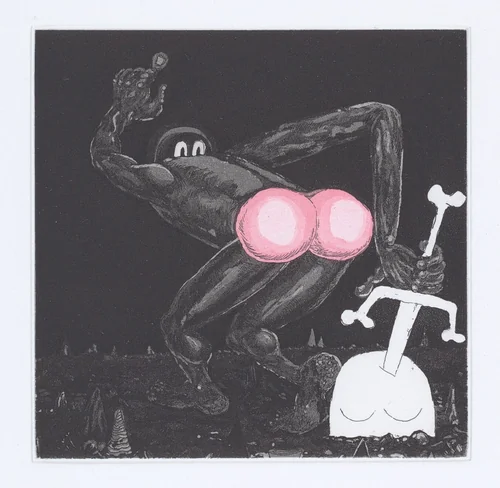
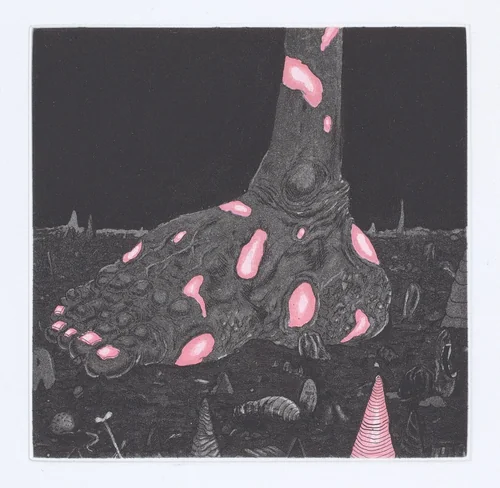
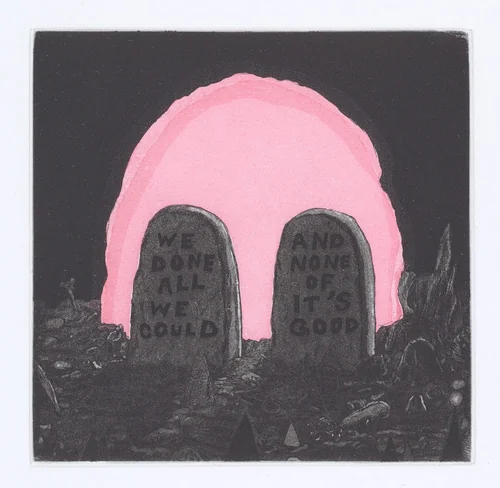
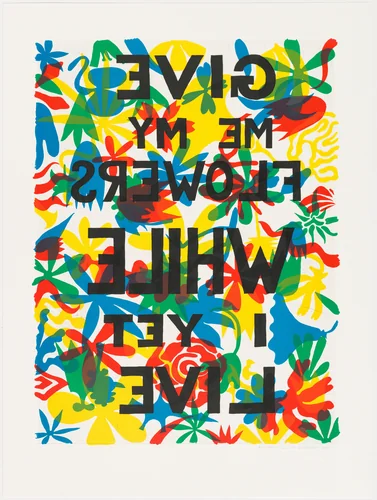
Hancock leverages printmaking to articulate specific, often crucial, moments within the Mounds saga. His graphical activity between 2010 and 2012 produced a definitive set of works that are foundational to the study of his narrative process. These include the intensely detailed Like a Thief in the Night, the dramatic The Night Foot, and the introspective pair of titles, Give Me My Flowers While I Yet Live and We Done All We Could and None of It's Good, A Nocturn. While his most immediate recognition often derives from his celebrated Trenton Doyle Hancock paintings, the graphical work demonstrates a mastery of line and composition, providing a necessary counterpoint to the dimensional intensity of his felt constructions.
What distinguishes Hancock is his unique ability to synthesize high-art historical references with the vernacular language of comics and underground culture. He employs a sincere, almost devotional visual language while simultaneously allowing space for dark humor and grotesque satire. This nuanced handling of tone transforms his personal mythology into a widely accessible exploration of morality, race, and identity. The continued inclusion of his graphic works in major archives, such as the National Gallery of Art, confirms their enduring museum-quality value. For scholars interested in this period of concentrated output, the circulation of high-quality prints sometimes allows closer access to the intricate narrative layers of this important contemporary voice.
Source: Wikipedia · CC BY-SA 4.0