Tiffany & Co.
Tiffany & Co. stands as the quintessential American specialty design house, defining luxury through design and craftsmanship for nearly two centuries. While the firm is globally recognized for its contemporary retail presence and mastery of diamond jewelry, its historical contributions to American decorative arts during the late 19th century established a standard for museum-quality silver, detailed design, and innovative metalwork. The house’s headquarters on Fifth Avenue became the undisputed center for American luxury goods, specializing particularly in sterling silver and high-quality jewelry.
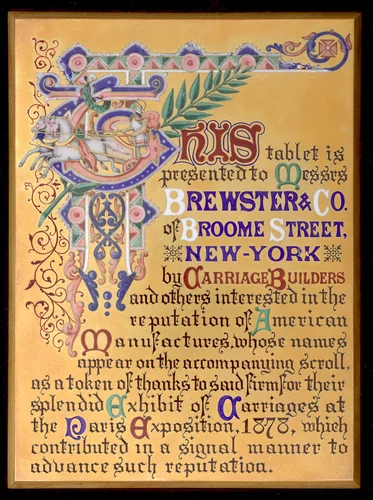
The firm’s artistic zenith in the late Gilded Age often focused on intricate metalwork and bespoke presentation pieces. Commissions from this era reflect Tiffany’s role as both artist and patron. A notable example is the elaborate Tablet presented to Brewster & Co. in 1878, an artifact recognizing the carriage firm’s exhibition success at the Paris Exposition Universelle. This dedication to custom artifacts reveals the complexity of the company’s design studio, which was tasked with producing highly detailed, large-scale artifacts that transcended simple retail inventory.
The design output documented between 1878 and 1893 also reveals a fascination with natural forms, typical of the emerging Art Nouveau influence in the United States. Preparatory sketches and formal studies illustrate the meticulous process of turning nature into luxury. Works such as the Study of Magnolia Blossom and the highly detailed Design Drawing for Magnolia Vase are foundational documents of American design history, often focusing on the transformation of floral motifs into enamels and intricate metal casings. The surviving drawings, including the Drawing of Magnolia Vase with Enameling Notations (?), underscore the rigorous internal system needed to translate delicate artistic studies into luxurious, finished objects. One fascinating historical detail often overlooked is the sheer volume of artistic documentation created during this period; the design house cataloged everything, resulting in an unexpected wealth of historical design studies now available as downloadable artwork for scholarly examination.
By maintaining exceptionally high-quality materials and technical standards, Tiffany & Co. cemented its status as a global leader in luxury design. Today, the design drawings and early conceptual pieces held in major institutions like the Metropolitan Museum of Art continue to inform art historians and designers, ensuring the enduring legacy of Tiffany & Co. far beyond the constraints of the showroom floor.
Source: Wikipedia · CC BY-SA 4.0