Tiffany and Company
Tiffany & Co. stands as the preeminent American luxury house, recognized internationally for its exceptional output in sterling silver, decorative arts, and high-quality diamond jewelry. Headquartered on Fifth Avenue in Manhattan, the company established itself not merely as a retailer, but as a crucial design studio that profoundly shaped the material culture of the late Gilded Age and the early 20th century. While its foundation dates back to 1837, the prolific activity documented between 1867 and 1897 firmly established the aesthetic vocabulary that remains synonymous with definitive American elegance.
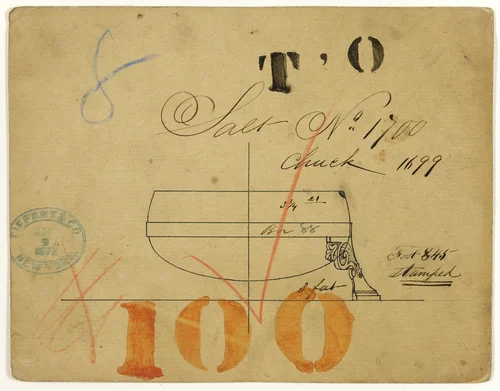
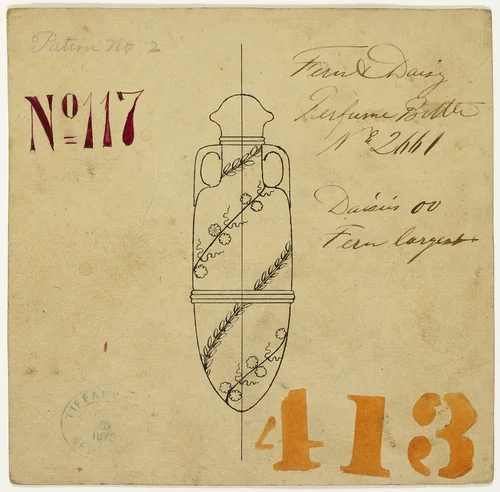
The firm’s significant contribution to the visual arts lies primarily in applied design and metalwork innovation. Tiffany designers produced meticulous preparatory drawings that blend technical precision with elaborate ornamental flourish, ensuring that every finished piece met exacting standards. These surviving works, now recognized as collectible art in their own right, illustrate the sophisticated processes required for high-end production. Examples such as the specification blueprint for the Hammering, Mounting and Engraving Design for Pitcher No. 5051 and the elegant pattern for the Design for Salt Dish No. 1700, reveal the company’s ability to merge industrial scale with bespoke craftsmanship. Tiffany designers perfected techniques in silversmithing and jewelry manufacture, incorporating both classical revival motifs and the emergent sensibilities of the Art Nouveau movement, visible in items like the detailed Design for Fern and Daisy Perfume Bottle No. 2661.
Tiffany & Co.’s influence extended far beyond jewelry cases, setting benchmarks that continue to define the global luxury market. Its historical pieces are represented in major institutional collections, including the Art Institute of Chicago, where they are studied for their material and historical significance. Although the modern corporation is known for licensing its brand across diverse categories, from fragrances to eyewear, the core legacy rests firmly in these design achievements. The comprehensive graphic designs and historical plans offer important insights into late 19th-century American aesthetics, with many of these studies now frequently available as high-quality prints for researchers and enthusiasts, providing open access to the firm’s detailed aesthetic history. This enduring body of design work certifies Tiffany not merely as a retailer, but as a foundational source for American decorative arts and museum-quality applied art.
Source: Wikipedia · CC BY-SA 4.0