Thomas Sandby
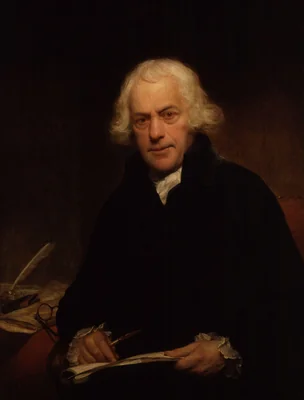
Thomas Sandby (1723-1798) occupies a crucial, yet often understated, position at the intersection of British architectural drawing, topographical watercolour, and aristocratic administration during the Georgian era. Appointed private secretary to the Duke of Cumberland in 1743, his career trajectory rapidly shifted from military mapping to the practical management and artistic documentation of some of England’s most ambitious pleasure grounds. This dual capacity as both a highly skilled draughtsman and an administrative officer gives his surviving works a rare documentary precision, charting major shifts in 18th-century British taste.
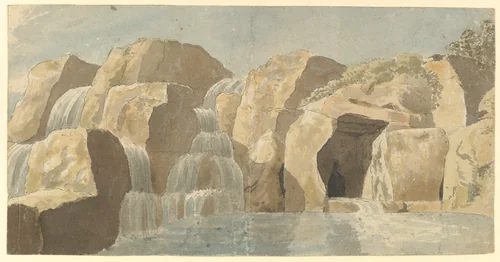
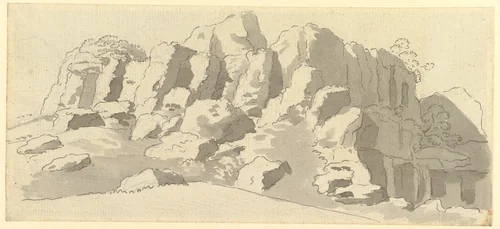
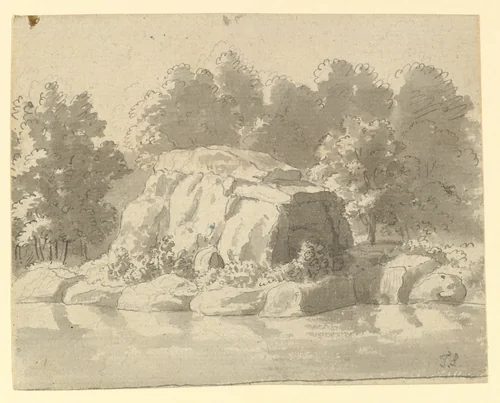
The most significant period of Sandby’s professional life began when he was appointed Deputy Ranger of Windsor Great Park. In this role, he oversaw considerable landscaping transformations, often working alongside his younger brother, Paul Sandby, whose artistic legacy sometimes eclipses Thomas’s foundational contributions. Thomas Sandby’s drawings were not merely representational studies; they were essential working documents for the implementation of monumental schemes. His highly detailed renderings, such as Design for rock-work and cascades at Virginia Water, Windsor Great Park, illustrate the era’s deep fascination with the Picturesque and the deliberate manipulation of natural features to achieve dramatic, almost theatrical, effect.
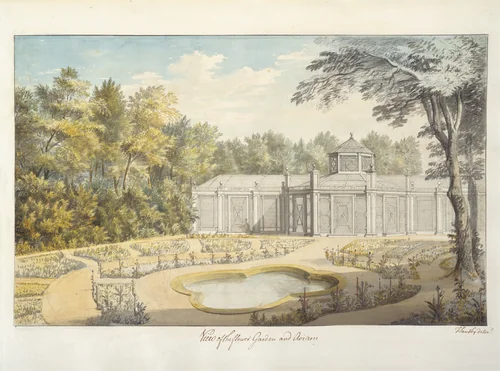
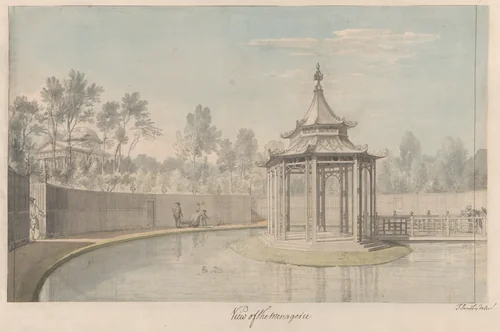
His precise linear style, characteristic of early British watercolour, captures the scale of these grand projects with exacting clarity. Drawings like the View of the Flower Garden and Aviary at Kew and View of the Menagerie at Kew are invaluable historical records of Enlightenment-era horticulture and exotic collections, preserving the ephemeral structures and planned landscapes of the royal estates. It is a peculiar historical footnote that Sandby successfully managed the rugged, large-scale transformation of the royal landscape while simultaneously holding the distinction of being a foundational academician, instrumental in establishing a structured approach to artistic education in Britain.
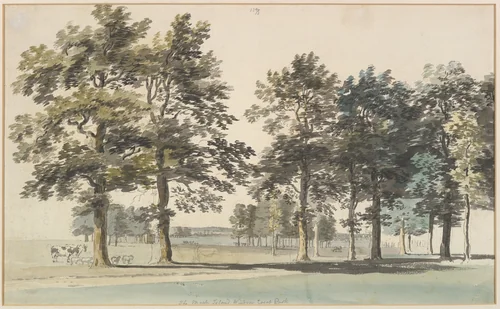
Today, his works, including studies like The Moat Island, Windsor Great Park, reside in major collections such as the Metropolitan Museum of Art. Fortunately, numerous high-quality prints derived from his technical yet evocative Thomas Sandby prints are widely available through the public domain, allowing broader access to the foundational imagery of British topographical art. His contribution ensures that these museum-quality drawings remain crucial documents for understanding the fusion of architecture and nature during the development of the Georgian aesthetic.
Source: Wikipedia · CC BY-SA 4.0