Thomas Kelah Wharton
Thomas Kelah Wharton was an English polymath of the visual arts, whose career encompassed the roles of landscape painter, draftsman, lithographer, and drawing teacher. Active in the late 1820s, Wharton specialized in meticulous topographical renderings that served not only as artistic expression but as crucial historical documentation of early nineteenth-century American estates.
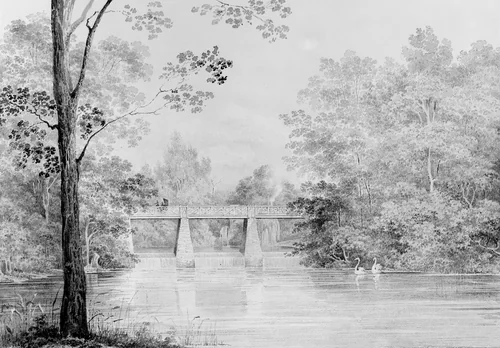
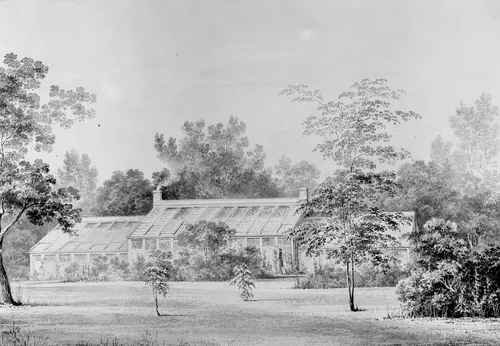
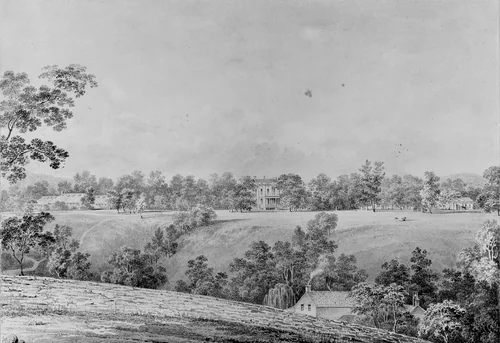
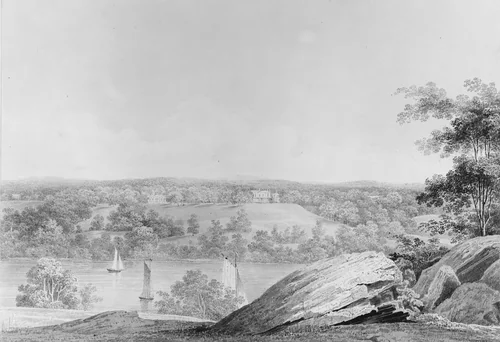
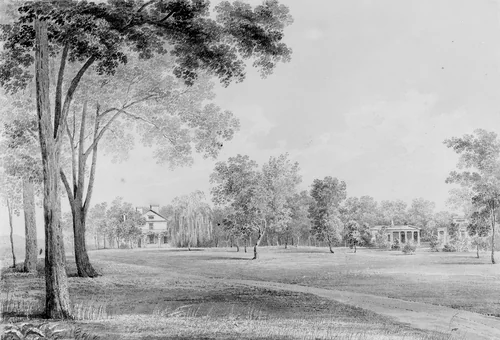
Wharton’s most significant body of work is preserved within the Hosack Album, currently held in the collection of the Metropolitan Museum of Art. Executed around 1829, these pieces detail the extensive Hyde Park estate of Dr. David Hosack, a prominent physician and botanist whose property represented the zenith of cultivated Hudson River landscape design. Wharton’s commissions provided a thorough visual inventory of this grand property, documenting architectural features and the intersection of manicured nature with engineered structures.
His compositions frequently framed the estate from various perspectives, providing a complete spatial understanding of Hosack’s vision. Works such as View of the David Hosack Estate at Hyde Park, New York, from the East and the focused study of the Greenhouse, David Hosack Estate demonstrate Wharton’s precise, almost pedagogical attention to line and form—an unsurprising characteristic given his profession as a drawing teacher. He transformed the functional duty of estate documentation into museum-quality visualizations.
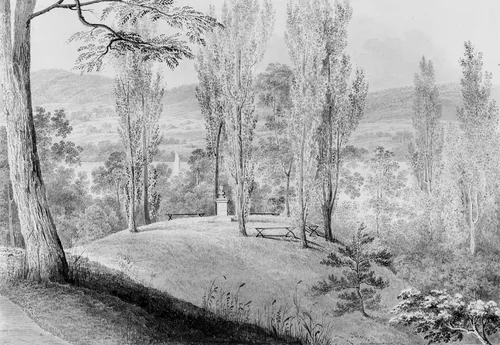
The drawings offer more than mere scenery; they capture the confluence of scientific endeavor and leisure wealth in the Antebellum North, providing primary evidence of early American landscape architecture. His work ensures that specific views, such as Grove of Poplars with a Memorial Bust, David Hosack Estate, are preserved for posterity. Wharton's detailed renderings contrast sharply with the looser, more subjective approaches of later Hudson River School painters.
Today, the meticulous nature of his draftsmanship is accessible to a wide audience. As many of these images have entered the public domain, the precise detail of Thomas Kelah Wharton prints remains an invaluable resource for architectural historians. His quiet dedication to topographical accuracy offers a unique window into the material culture of the period.
Source: Wikipedia · CC BY-SA 4.0