Thomas Allom
Thomas Allom (1804-1872) occupied a fascinating and productive intersection of 19th-century English professional life, operating successfully as both a respected architect and an immensely popular topographical illustrator. His commitment to establishing professional standards within his field was evident in his role as a founding member of the organization that would later become the Royal Institute of British Architects (RIBA).
Trained thoroughly as an architect, Allom made significant contributions to the rapidly developing urban landscape of London. His designs include the striking Church of St Peter's and critical segments of the elegant Ladbroke Estate in Notting Hill. Furthermore, his high standing within the profession is underscored by his extensive collaboration with Sir Charles Barry, most notably on the monumental project of the new Houses of Parliament, where Allom’s mastery of draftsmanship was essential.
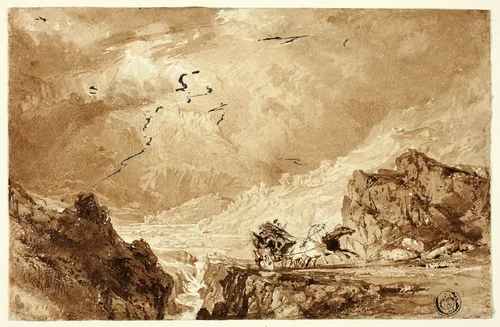
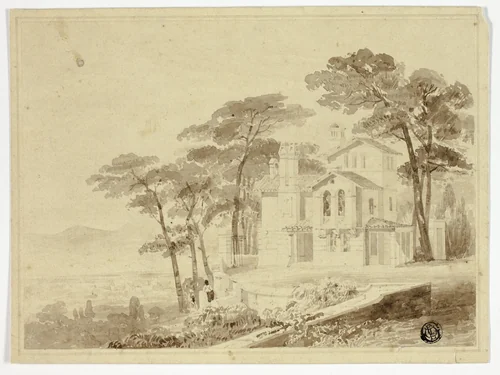
Yet, it is through the widespread dissemination of his drawn works that Allom secured his broad international renown. His illustrations, whether capturing the structural drama of The Diligence in the Alps or the quiet elegance of Villa in Naples, were highly sought after by publishers seeking detailed, reliable images of exotic locales for the expanding Victorian readership. These works possessed an aesthetic clarity and precise perspective ideally suited for the etching process.
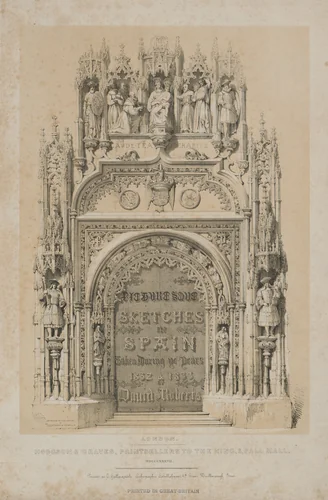
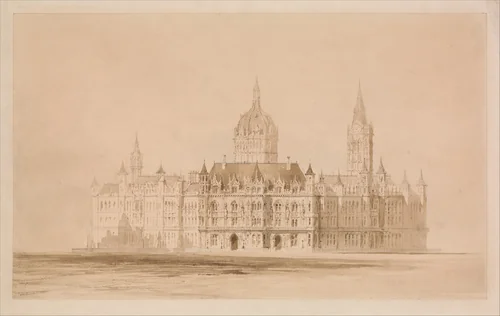
The success of these graphic works lay in the artist’s unique ability to blend the precision of an architect with the romance of travel. Even in his most picturesque scenes, such as those that might have influenced works like Picturesque Sketches in Spain: Title Page, the rendering of structure and proportion remained impeccable. This rigor is equally evident in official drawings like the Competition Drawing for the Manchester Town Hall.
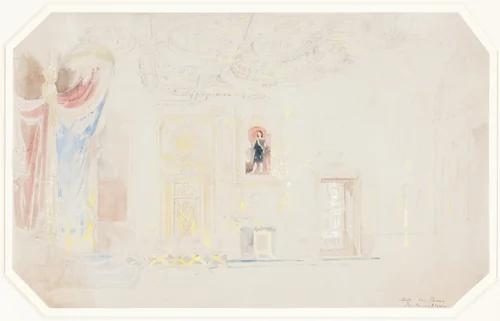
His defining illustrative projects include the definitive 1838 volume, Constantinople and the Scenery of the Seven Churches of Asia Minor, followed by the ambitious, four-volume China Illustrated (1845). These works defined the visual perception of Asia Minor and the Far East for an entire generation. Today, this massive output ensures that Thomas Allom prints and original sketches, such as the view of The Throne Room at Fontainebleau, are widely accessible. Owing to the age of the original plates, much of his visual catalogue is now in the public domain, making downloadable artwork of these high-quality prints a valuable resource for historians and collectors alike.
Source: Wikipedia · CC BY-SA 4.0