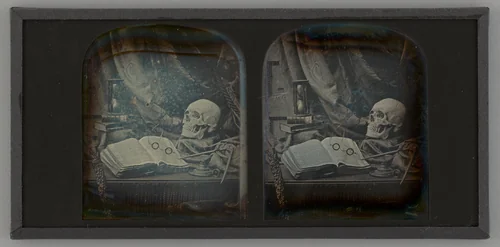
T. R. Williams
Thomas Richard Williams (1825-1871) was a foundational figure in early British photography and a critical pioneer in the development and popularization of stereoscopy. Active professionally during the 1850s, a crucial decade for the establishment of photography as a commercial and artistic medium, Williams was instrumental in perfecting the stereoscopic image, translating the illusion of three-dimensional depth onto dual photographic plates.
His body of work, though focused within a short timeframe, demonstrates exceptional technical command and compositional sophistication. Williams excelled in the genre of the studio still life, utilizing the unique capabilities of stereography to render volume and texture with remarkable clarity. His celebrated series featuring exotic birds, exemplified by works such as Still-Life with Cockatoo, Ornamental Ball, Lace, Statuette, are meticulous compositions that recall the rich symbolism and domestic interiors of seventeenth-century Dutch painting. These compositions masterfully play with light and deep shadow, transforming everyday objects like lace, feathers, and decorative items into studies of material culture suitable for museum-quality display.
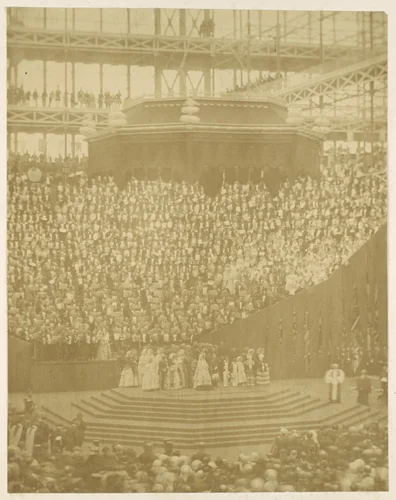
Beyond his intricate studio work, Williams’s career spanned important documentary and public commissions. He undertook the massive task of visually recording significant historical events, including the 1854 documentation of the reconstructed Crystal Palace. His work, Queen Victoria Presiding at the Reopening of the Reconstructed Crystal Palace at Sydenham, stands as a vital historical record and a technical achievement in grand-scale outdoor documentation using the wet-plate collodion process.
It is noteworthy that despite the technical challenges and inherent novelty of this groundbreaking medium, Williams consistently favored the controlled environment of the studio, preferring the exacting precision required by staged compositions over the spontaneity of landscape or portraiture. His dedication ensured that his images were always technically superior and commercially successful. Today, works by Williams are housed in major international collections, including the Metropolitan Museum of Art and the Art Institute of Chicago. As many of these T. R. Williams prints now reside in the public domain, they remain accessible as high-quality prints and downloadable artwork, solidifying his legacy as one of the most innovative visual storytellers of the Victorian era.
Source: Wikipedia · CC BY-SA 4.0
![[Stereograph Still-life of Fowl with Initialed Barrel and Root Vegetables] by T. R. Williams, photograph, 1850-1859](https://img.artbee.org/b0b6f8c2-82cf-412a-95e5-510e88e57a1b/small.webp)
![[Still-Life with Cockatoo, Mirror, Ornamental Ball, Vases, and Lace] by T. R. Williams, photograph, 1850-1859](https://img.artbee.org/f40e118f-26bc-41bf-8f95-c75c82741851/small.webp)
![[Still-Life with Cockatoo, Ornamental Ball, Lace, Peacock Feathers] by T. R. Williams, photograph, 1850-1859](https://img.artbee.org/bceb433b-75f3-49c7-940e-67185f48eff8/small.webp)
![[Still-Life with Cockatoo, Ornamental Ball, Lace, Statuette] by T. R. Williams, photograph, 1850-1859](https://img.artbee.org/468470d3-ffa7-4970-86e4-6b2ad6e3d97e/small.webp)
![[Still-life of Game with Rake and Onion Jar] by T. R. Williams, photograph, 1854-1860](https://img.artbee.org/c3d9b22d-3d71-434b-8023-55d64278d168/small.webp)