Stuart Davis
Stuart Davis (1892–1964) stands as one of the most intellectually rigorous and formally inventive American modernists. His long career was dedicated to fusing the complex geometries of European Cubism with the vernacular language and boisterous visual culture of the United States.
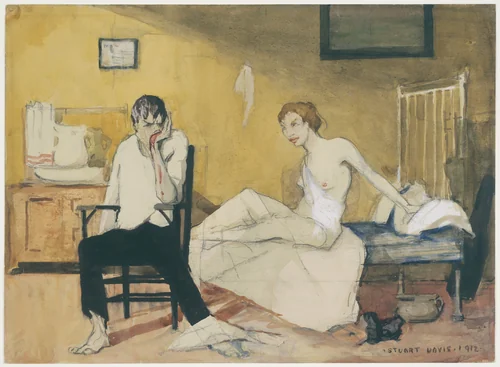
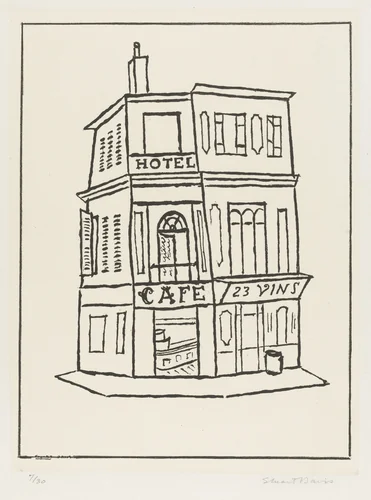
His trajectory was established immediately following the 1913 Armory Show, where his exposure to Post-Impressionism and European abstraction propelled him away from his earlier illustrative roots. The critical years between 1912 and 1928 mark his rapid development, moving from early figurative sketches, such as the lively Hotel Café, toward pure formal experimentation.
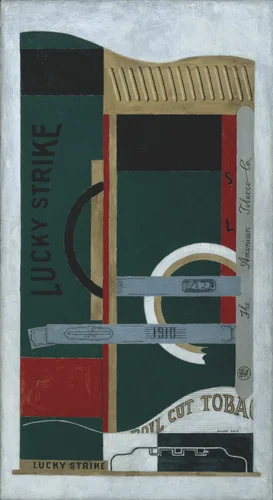
Davis quickly recognized the artistic potential inherent in everyday American signage and consumer packaging, themes previously ignored or dismissed by his peers. Where earlier artists sought classical motifs or grand historical subject matter, Davis saw formal energy in advertising. He pioneered the use of commercial trademarks and text as fundamental structural elements, famously elevating mundane packaging to the level of high art. He treated a simple cigarette package, as seen in his early study Lucky Strike, with the same formal rigor afforded a still life by Cézanne.
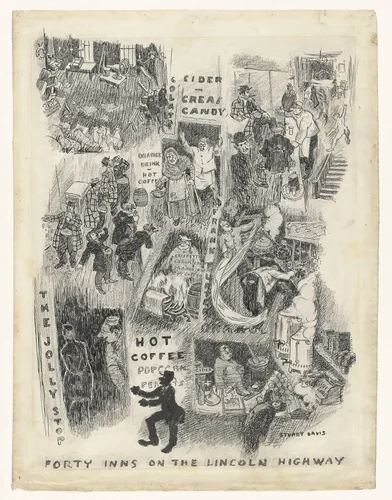
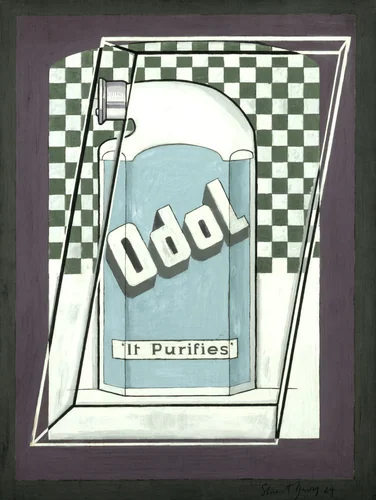
This period saw the creation of seminal Stuart Davis paintings, including the chemically vivid Odol and the dynamic, graphic language of The Front Page. He began to distill the chaotic energy of the American road trip and commercial architecture into controlled, often abstract patterns, exemplified by works like Forty Inns on the Lincoln Highway.
Davis’s insistence on marrying flat planes, vibrant color, and jazz-like syncopation cemented his reputation as a master of syncopated Cubism. Although many of his groundbreaking original works are held in major institutional collections, including the Museum of Modern Art, his influence continues to reach a global audience today. Many of his formative images are widely distributed as high-quality prints and are increasingly available as royalty-free downloadable artwork, securing his legacy as a central figure in American abstraction.
Source: Wikipedia · CC BY-SA 4.0