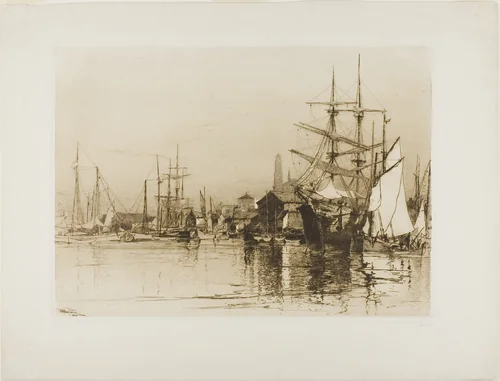
Stephen Parrish
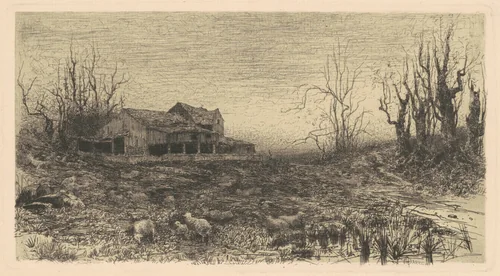
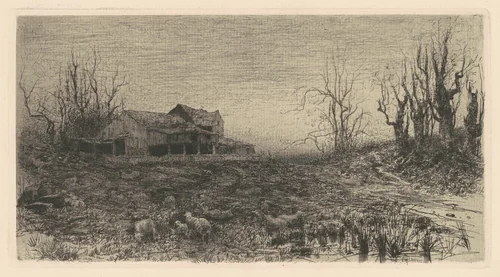
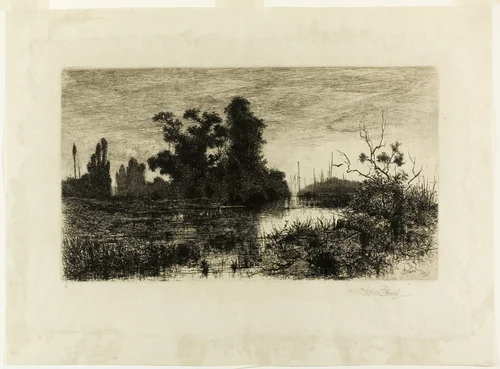
Stephen Parrish (1846-1938) holds a distinguished position among the most significant American printmakers of the late nineteenth century. He was a pivotal figure in the artistic phenomenon known as the American Etching Revival, whose success fundamentally elevated printmaking from a reproductive medium to an autonomous high art form in the United States. While he also engaged in painting, it was his nuanced and atmospheric handling of the etched line that cemented his national celebrity.
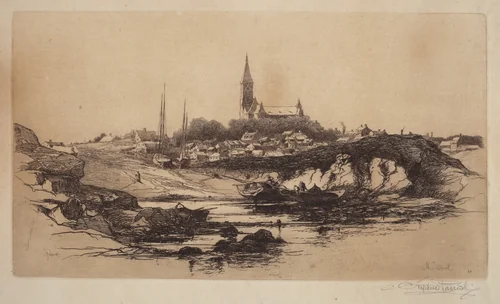
Parrish was largely self-taught, although he refined his draftsmanship through private instruction with the accomplished painter and animal etcher Peter Moran. Parrish’s focus settled almost exclusively on the delicate drama of the Eastern North American coast. He specialized in capturing the ephemeral conditions of water, light, and atmosphere, particularly depicting the historic harbors, villages, and marine infrastructure of New England and Canada.
His technical mastery was exceptional, allowing him to produce etchings that were both topographically accurate and deeply evocative. Works like The Inner Harbor, Gloucester and Marblehead exemplify this precision, demonstrating a complex balance between detailed observation and a moody, romantic sensibility characteristic of the period. Parrish’s contribution was essential to the cultural acceptance of the etching medium. His celebrated prints were keenly collected by institutions and private patrons alike, and today, his work is held in major collections, including the Art Institute of Chicago and the National Gallery of Art.
One might observe that Stephen Parrish demonstrated a remarkable ability to generate artistic legacy across generations; he is also noted as the father of the immensely popular Golden Age illustrator, Maxfield Parrish. The enduring quality of Stephen Parrish prints ensures that they remain a cornerstone of American graphic arts history. Many of his images, embodying the spirit of Victorian coastal life, are available in the public domain, offering contemporary audiences easy access to museum-quality artistry.
Source: Wikipedia · CC BY-SA 4.0