Spinello Aretino
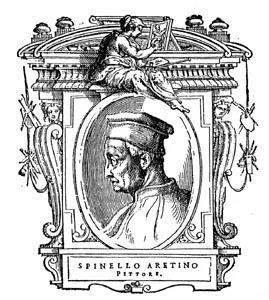
Spinello Aretino (ca. 1350–1410) was an essential Italian painter hailing from Arezzo whose artistic production spanned the crucial transition from the late 14th to the early 15th century. Operating primarily in Tuscany, his distinct style played a fundamental role in shaping the subsequent development of regional painting during the period immediately preceding the Renaissance breakthrough. His active years, documented between 1384 and 1405, cemented his reputation as a prolific master adept at both grand fresco cycles and intimate devotional panels.
Aretino's visual language synthesized the decorative grace typical of Sienese masters with the structural solidity favored in Florence, resulting in a dramatic, narrative clarity. Though much of his documented fresco work has suffered the ravages of time, his surviving panel paintings offer valuable insight into his technique. These works demonstrate a consistent commitment to rich color palettes and complexly organized compositions, features that make his work instantly recognizable.
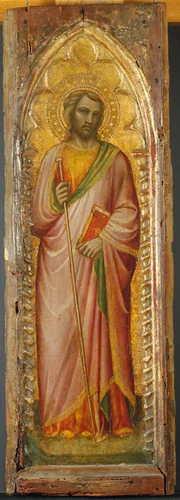
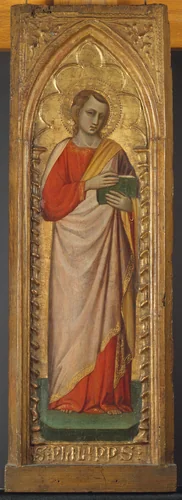
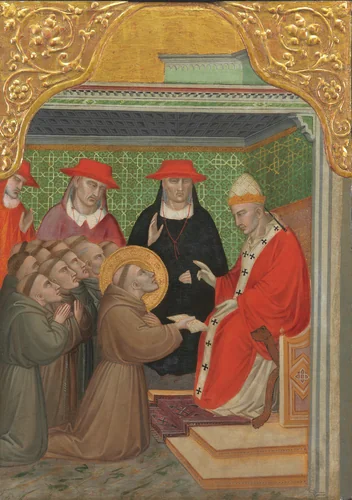
Major institutions worldwide recognize Aretino’s contribution to the Trecento legacy. Key Spinello Aretino paintings are held in North American collections, including the Metropolitan Museum of Art and the Art Institute of Chicago. The Metropolitan Museum holds important single-figure depictions, notably A Saint, Possibly James the Greater and Saint Philip. These smaller devotional pieces contrast with his more ambitious narrative work, such as Saint Francis before the Pope (The Approval of the Franciscan Rule), which showcases his skill in managing multiple figures within a coherent architectural space.
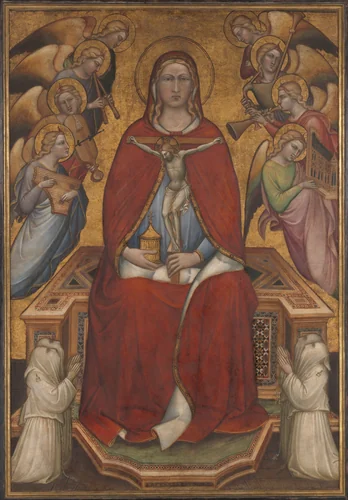
A subtle yet practical aspect of his workshop production involved the creation of dual-sided panels, reflecting the necessity of highly versatile sacred objects. The work Saint Mary Magdalen Holding a Crucifix; (reverse) The Flagellation illustrates this practice, offering two distinct scenes separated by a thin wooden support. These works were designed to function effectively in both static display and liturgical processions, combining high-quality prints and painting techniques with utilitarian design. Today, the enduring presence of these works, many of which are now available as downloadable artwork for scholars and enthusiasts, underscores Aretino’s pivotal role as an influential interpreter of Gothic traditions at the cusp of modernity.
Source: Wikipedia · CC BY-SA 4.0