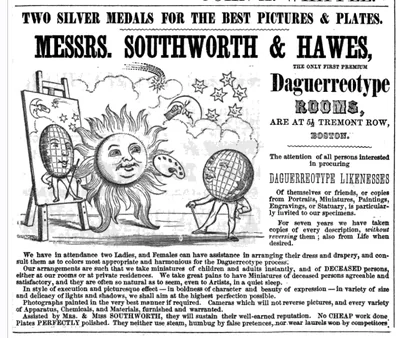
Southworth and Hawes
Southworth & Hawes, active in Boston between 1843 and 1863, represents the earliest pinnacle of photographic achievement in the United States. Composed of Albert Sands Southworth (1811-1894) and Josiah Johnson Hawes (1808-1901), the firm quickly transcended simple documentation, fundamentally repositioning the photographic portrait as a medium capable of fine art expression. They are universally celebrated as the first great American masters of the camera, setting the aesthetic standard for high-quality portraiture during the mid-nineteenth century.
Operating during the height of the Daguerreotype era, Southworth and Hawes distinguished themselves through careful artistic choices rather than mere mechanical speed. Their studio rejected the flat, hurried poses common to commercial photography, opting instead for dramatic natural lighting, subtle shadowing, and expansive compositions that gave their sitters psychological depth and gravitas. This elevated approach, often requiring prolonged exposures, demanded remarkable patience from notable subjects such as orator Daniel Webster and politician Charles Sumner. Their technical mastery ensured that the reflective nature of the polished silver plates captured not just likeness, but profound presence.
Southworth, trained initially as a pharmacist, brought a scientific precision and keen focus to the technical aspects of the studio, while Hawes often managed the day-to-day operations and maintained the business after Southworth’s eventual retirement. This division of labor allowed for an unprecedented consistency in the work, which became immediately influential, establishing a distinctive Bostonian style admired both locally and internationally.
Their partnership’s definitive images remain central to the history of the medium and are prominent in major collections, including the holdings of the Metropolitan Museum of Art. Today, the accessibility of these historic images, now often available as high-quality prints or downloadable artwork via the public domain, allows a new generation to study the rigor and aesthetic ambition of their photographic contributions. It is perhaps fitting that these two men, who captured the defining faces of their generation, are frequently studied through their own intense and rigorous self-portraits, offering a rare window into the focused methodology required of the nineteenth-century photographic artist.
Source: Wikipedia · CC BY-SA 4.0
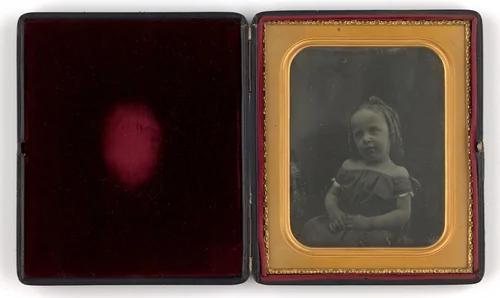
![[Augusta Hawes at Four Years Old] by Southworth and Hawes, photograph, 1850-1859](https://img.artbee.org/83932f43-607d-4e59-a09d-6f9fb6076eb9/small.webp)
![[Young Man in Three-piece Suit and Bow Tie] by Southworth and Hawes, photograph, 1850-1859](https://img.artbee.org/3216e410-b234-49d6-8893-f298d4c35dc4/small.webp)
![[Young Woman Wearing Lace Collar and Brooch] by Southworth and Hawes, photograph, 1850-1859](https://img.artbee.org/faa03efc-d4d1-449c-9844-b3bc1becd1f9/small.webp)
![[Young Woman with Hair Styled in Two Buns] by Southworth and Hawes, photograph, 1850-1859](https://img.artbee.org/2c279003-6d13-4a95-9c35-27a733409152/small.webp)
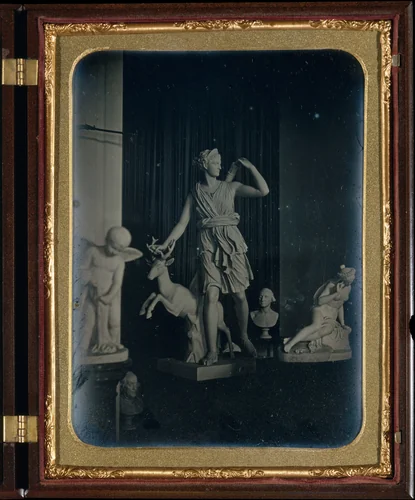
![[View Down Brattle Street from the Southworth & Hawes Studio at 5 1/2 Tremont Row, Boston] by Southworth and Hawes, photograph, 1855](https://img.artbee.org/7799ca2b-b629-4123-abef-0f78150f59a5/small.webp)