Sir James Thornhill
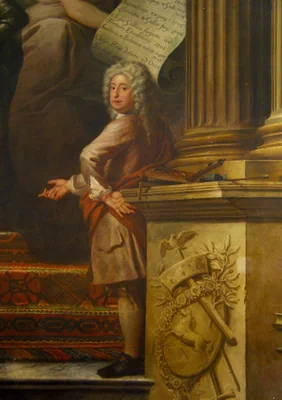
Sir James Thornhill (1675-1734) holds a singular place in English art history, recognized as the nation’s foremost native-born historical painter during the early eighteenth century. Working firmly within the established Italian Baroque tradition, his primary legacy rests upon monumental, site-specific mural schemes designed to glorify British state power and architecture. His career culminated in projects of unrivaled scale, including the vast, trompe l’oeil ceilings of the famed “Painted Hall” at the Royal Hospital, Greenwich, and the imposing interior paintings of the dome of St Paul’s Cathedral. These immense commissions effectively defined the visual language of public grandeur in Britain for a generation.
Unlike many of his continental peers, Thornhill faced the considerable challenge of establishing a credible, high-status English school of history painting. He achieved this by adapting continental models, particularly the dynamism and complex allegory of Roman and French decorative styles, to suit English architectural scales and political sensibilities. His large-scale narrative compositions, frequently incorporating classical mythology or Christian subjects, are characterized by dramatic foreshortening and a theatrical sense of movement. This talent for high-stakes allegory ensured he cornered the market for major public commissions, making him the first native English artist to be formally knighted for his artistic achievements.
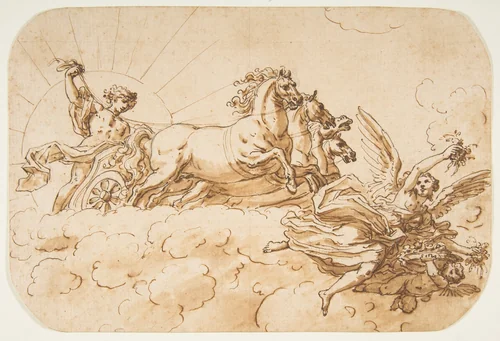
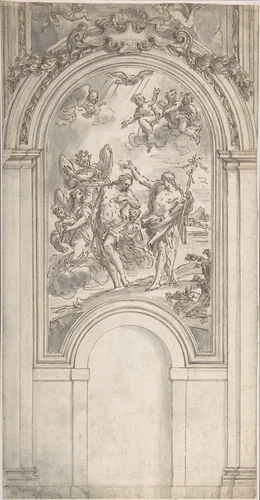
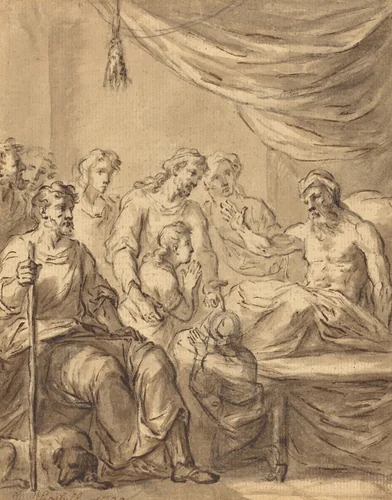
The intellectual ambition inherent in his massive murals, which also include significant works at Chatsworth House and Wimpole Hall, often begins to surface in his meticulous preparatory studies. The drawings that survive in important institutions like the Metropolitan Museum of Art and the National Gallery of Art offer direct insight into his conceptual process. Designs such as the powerful Chariot of Apollo and the complex architectural study for a Design for a Baptism of Christ in an Architectural Setting reveal the clarity with which Thornhill planned his grand narratives. One delightful observation about Thornhill is that his practical success led him not only to the title of Sergeant Painter but also to the profitable establishment of an art academy in his own house, guaranteeing he would literally paint the next generation of English talent into existence.
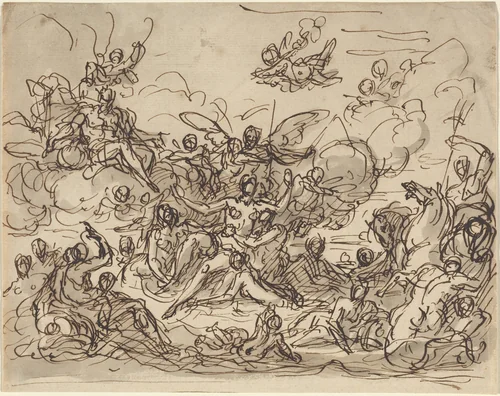
Thornhill’s prolific output provided a crucial bridge between continental opulence and the emerging restraint of Georgian classicism. While the majority of his finished Sir James Thornhill paintings remain fixed to their architectural settings, his detailed concepts, such as the Birth of Venus design, are today accessible globally. Because of the age of his originals, many preparatory works and related designs are considered public domain, allowing institutions to make high-quality prints and downloadable artwork available for scholarly and public appreciation worldwide.
Source: Wikipedia · CC BY-SA 4.0