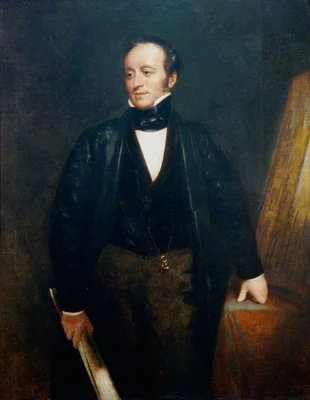
Sir Charles Barry
Sir Charles Barry FRS RA was a foundational architect of the Victorian era, universally recognized for overseeing the ambitious rebuilding of the Palace of Westminster in the mid-19th century following the disastrous fire of 1834. While Westminster remains his defining public project, Barry’s profound historical significance lies in his masterful adaptation and popularization of Italianate architecture throughout Britain.
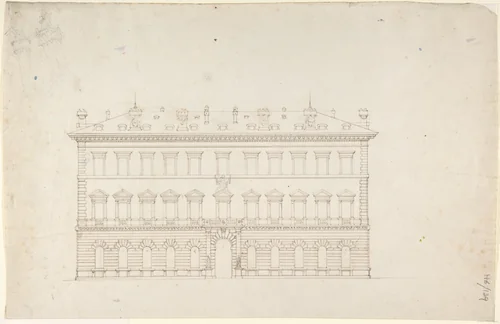
Barry was instrumental in shifting British design tastes toward classical rigor and restraint. He championed the use of the Italian Renaissance Palazzo as a primary design model, applying its stately symmetry and layered facades not just to aristocratic country houses but also to extensive city mansions and essential public buildings. His commitment to these classical prototypes is evident in his architectural concepts, such as the surviving drawing Design for a Public Building in the Italian Renaissance Palazzo Style. As an architect deeply rooted in history, his influential designs remain popular subjects for study, and numerous Sir Charles Barry prints are sought after by collectors.
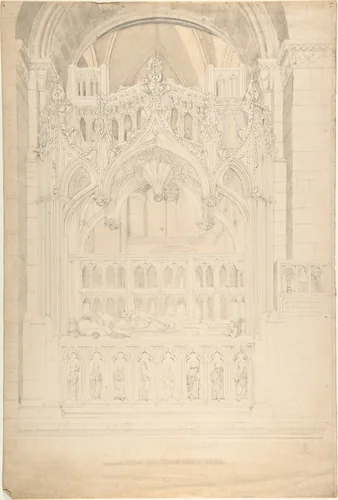
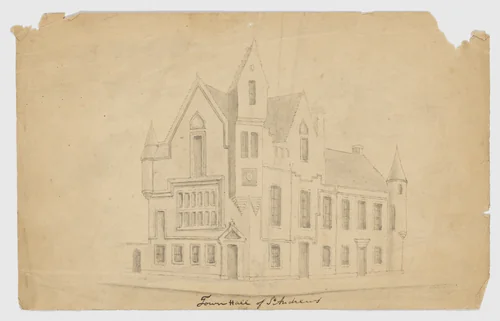
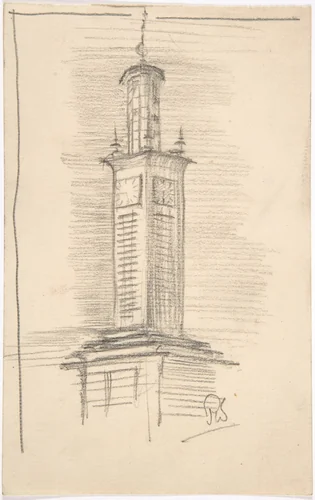
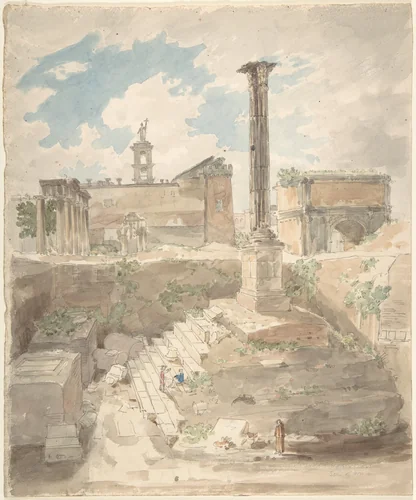
His early career was marked by the rigorous discipline of the traditional Grand Tour. During this period, he produced meticulous preparatory studies and topographical views that informed his later work, revealing the depth of his classical education. Examples include detailed renderings like Monument of Bishop Mays, Hereford Castle AD1516 and the topographical study View of the Roman Forum, unexcavated. These early drawings confirm his foundational understanding of historical context and proportion, which he later seamlessly injected into the British urban environment through structures like St. Andrews Town Hall and the imposing design of the Clocktower.
Barry was not merely concerned with the building structure itself; he acted as a total environment architect. He systematically developed the Italian Renaissance garden style to accompany his major commissions, ensuring that the architecture transitioned harmoniously into its surrounding landscape. He cultivated formality and order in the grounds, mirroring the symmetry of the built structures. It is perhaps the highest compliment to his thorough integration of design that a Barry project often feels less like a structure placed upon the landscape and more like an inevitable, organized geological event. Today, many of his important preparatory studies and designs, preserved in major collections like the Metropolitan Museum of Art, are often released into the public domain, allowing institutions to generate high-quality prints for educational use.
Source: Wikipedia · CC BY-SA 4.0