Sion Longley Wenban
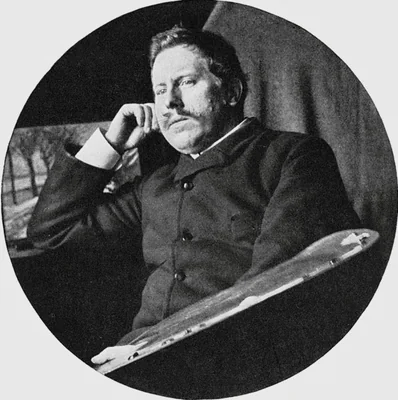
Sion Longley Wenban (1841-1897) was an American landscape painter and graphic artist whose mature career developed almost entirely in Germany following his emigration. Active primarily between 1870 and 1883, Wenban is perhaps best understood through his distinctive approach to printmaking, which elevated the technical possibilities of the etched plate into subtle atmospheric studies. His work is held in major American institutions, notably the Cleveland Museum of Art, reflecting his dual cultural citizenship.
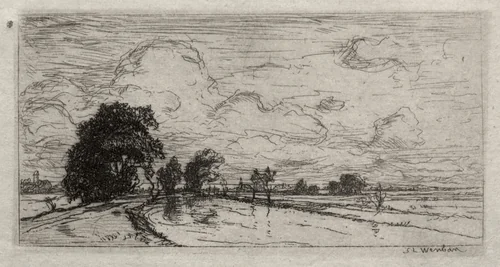
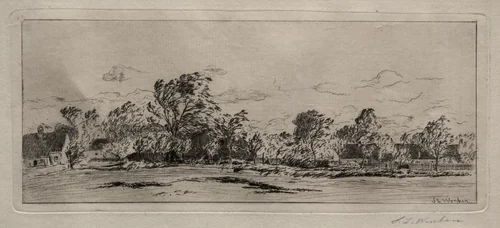
Wenban focused his considerable talent on depicting the fleeting conditions of light and atmosphere, often capturing scenes just at the point where weather transforms the everyday. This is evident in key pieces such as Windy Morning - Schleissheim, which avoids the heroic drama common to 19th-century landscape painting, favoring instead a concise depiction of motion and air. Similarly, Flooded Landscape with Trees demonstrates a mastery of tone, using the stark contrast between saturated ground and skeletal forms to evoke the chilly stillness of winter water.
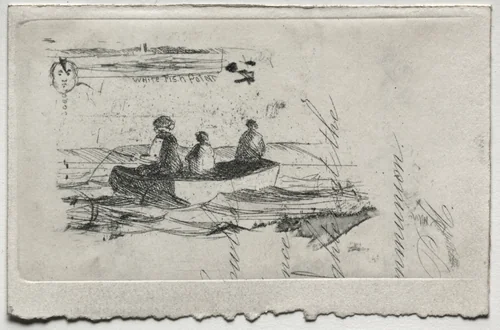
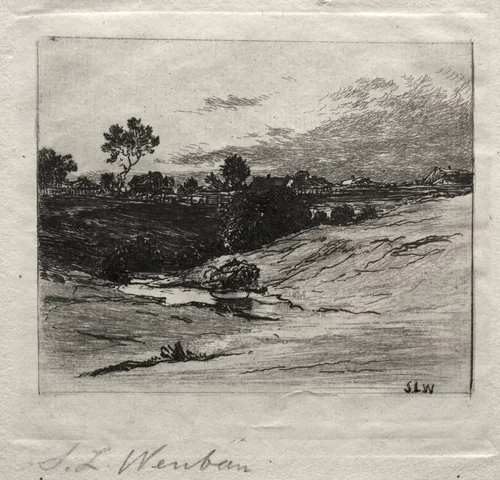
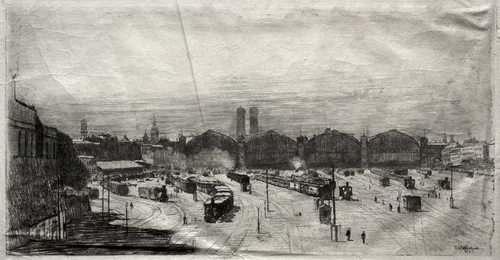
While his surviving catalog is focused, the breadth of his subject matter reveals an artist attentive to both nature and the encroaching industrial age. His print Railroad Station stands out as a perceptive study of modern infrastructure, handling the smoke and structured geometry of the station with the same atmospheric reverence he applied to rural scenes like Fishing. This ability to find visual poetry in both traditional and contemporary settings distinguishes his output.
As a graphic artist, Wenban produced high-quality prints that achieved a remarkable depth, suggesting the tonal richness of charcoal or oil while maintaining the crisp line essential to the etching process. Today, many of Sion Longley Wenban prints and related materials are held in the public domain, making his nuanced vision of the late 19th-century European landscape accessible globally. It is worth noting, quietly, that for a figure who lived primarily abroad, his prints are surprisingly effective at conveying a distinctly North American sense of scale, perhaps a lingering memory of home filtering into his adopted landscape. His legacy endures through these surviving images, offering museum-quality records of a transitional period in graphic art.
Source: Wikipedia · CC BY-SA 4.0