Sassetta
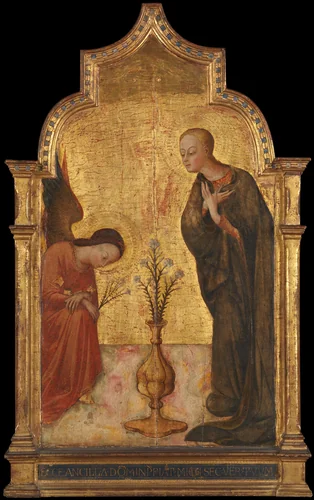
Sassetta, or Stefano di Giovanni, stands as the undisputed master of painting in Siena during the first half of the Quattrocento. Active specifically between 1432 and 1445, he worked at a critical juncture in Italian art history, successfully navigating the transition from the courtly lyricism of the International Gothic style towards the narrative clarity of the nascent Renaissance. His significance rests not in adopting Florentine innovations wholesale, but in purifying and elevating the inherent elegance of Sienese pictorial tradition, emphasizing delicate color harmony and linear grace.
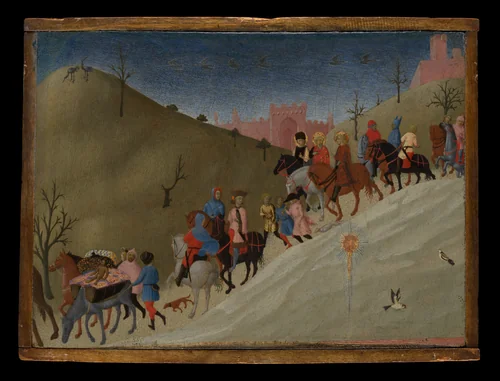
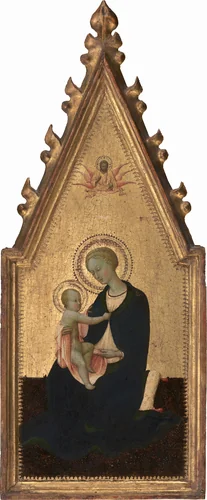
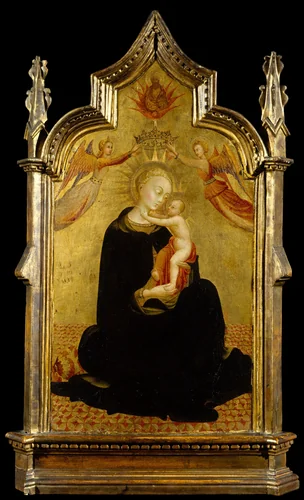
Sassetta’s skill was uniquely suited to creating expansive cycles and complex predella panels that demanded both intimacy and high drama. His surviving works demonstrate a powerful command over storytelling. Panels like The Journey of the Magi reveal his sophisticated handling of space, guiding the viewer through vast, brightly lit settings with remarkable ease. Similarly, the devotional power inherent in his smaller works, such as the contemplative Madonna of Humility, shows a profound ability to render spiritual subjects with approachable human tenderness.
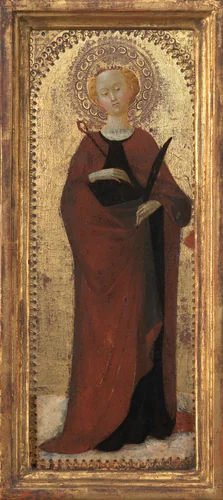
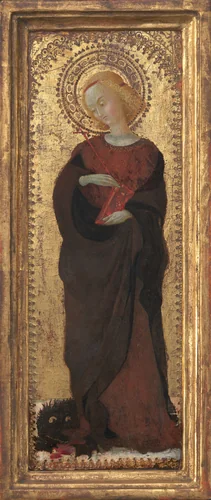
The fragmentation of Sassetta’s large polyptychs, dispersed across institutions over centuries, has ironically ensured the widespread recognition and rigorous study of his genius. Individual components, including the beautifully preserved Saint Apollonia and Saint Margaret, highlight his characteristic fusion of sharp detail and flowing compositional rhythm. His approach maintained a spiritual intensity that often contrasted sharply with the rising secular trends elsewhere in Tuscany, making his output the last great flowering of the Sienese medieval aesthetic before the full ascendancy of Renaissance classicism.
Today, a small, highly prestigious selection of Sassetta paintings resides in major American collections, including the Metropolitan Museum of Art, the National Gallery of Art, and the Cleveland Museum of Art. These museum-quality works are central to understanding Sienese art history. In the contemporary environment, access to his visual legacy has expanded; the core body of his documented output is now available as high-quality prints, ensuring that his distinct, fragile artistry continues to reach a global audience.
Source: Wikipedia · CC BY-SA 4.0