Salomon de Caus
Salomon de Caus (c. 1576–1626) holds a pivotal position in the history of seventeenth-century technology and design. Known officially as a French engineer and architect, de Caus was instrumental in translating sophisticated scientific theories into practical, spectacular applications across the courts of Northern Europe. During a highly concentrated period of activity between 1612 and 1620, his published works served as essential manuals for the construction of elaborate pleasure gardens, grottoes, and the mechanical objets d'art that defined early Baroque luxury.
His treatises, collected today by institutions such as the Metropolitan Museum of Art, demonstrate a thorough command of multiple disciplines. De Caus’s work often balanced visual aesthetics with rigorous calculation. His foundational volume, La Perspective, provided detailed geometric instructions crucial for the accurate depiction of architectural space, a central concern for designers of the era. Complementing this visual geometry, Institution Harmonique explored the mathematical ratios governing music and sound, placing de Caus firmly within the tradition that viewed architecture and engineering as manifestations of cosmic harmony.
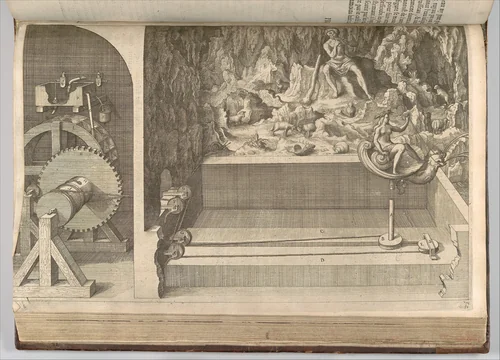
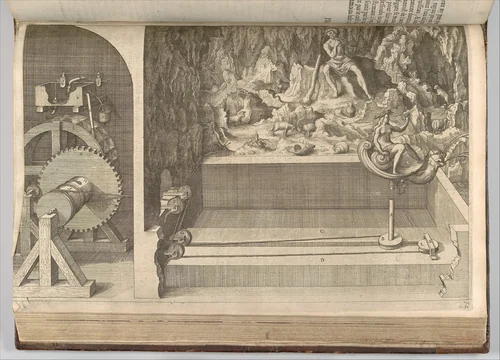
Perhaps his most enduring influence is found in the application of physics, detailed across the volumes of Les Raisons des Forces Mouvantes. This work, appearing in two books, provided definitive instructions for creating complex waterworks and pneumatics, focusing specifically on hydraulic engineering used to animate garden sculptures. The accompanying illustrations, often sought today as high-quality prints, detail ingenious mechanisms for automated movement.
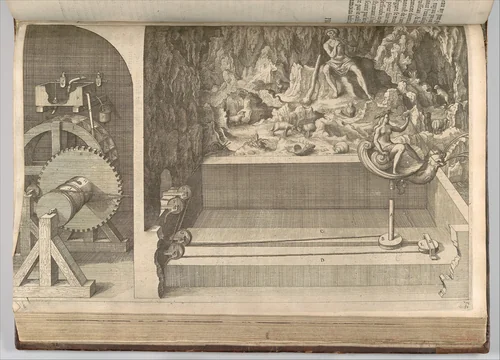
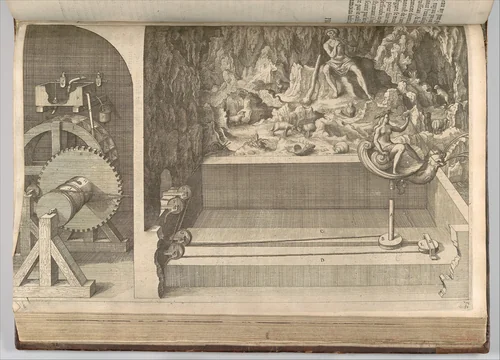
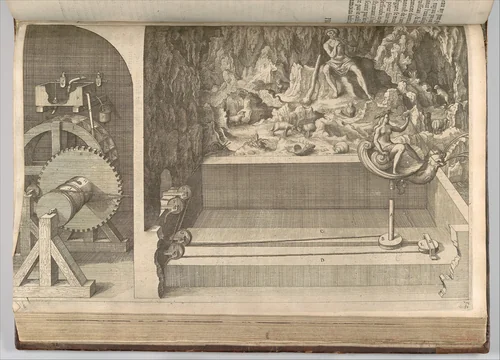
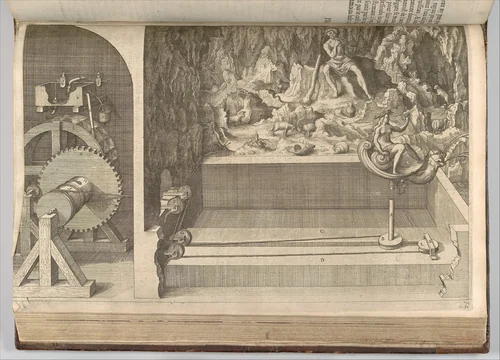
A particularly captivating example is his detailed diagram for Problem XXIIII: A Machine for a Moveable Galatea in a Grotto (Plate 32). It is here that the engineering genius of de Caus meets the demands of courtly whimsy: the mastery of mechanical force was consistently deployed in service of aristocratic wonder, transforming raw pressure into mythological theater. His comprehensive six-part body of work, including the Miscellany of the Work of Salomon de Caus, provided not merely theoretical blueprints but practical guides to achieving museum-quality mechanical precision, underscoring the powerful cross-pollination between early science and artistic sensibility.
Source: Wikipedia · CC BY-SA 4.0