Rudolf Eickemeyer
Rudolf Eickemeyer occupies a unique, transitional position in the history of nineteenth-century European military and intellectual life. Born Jean Marie Rodolphe Eickemeyer, and also known as Heinrich Maria Johann Rudolf Eickemeyer, his primary professional distinction lay outside the arts, yet his subsequent legacy endures through his highly collected photographic output. Eickemeyer was a formidable intellect who achieved professional stature as an engineer, a mathematician, and ultimately, a general during the volatile era of the French Revolutionary Wars. Born in Mainz, he concluded his long career in Gau-Algesheim, a town now situated in the Mainz-Bingen district of Rhineland-Palatinate.
Eickemeyer’s active artistic period, circa 1890 to 1901, represents a late-career foray into the burgeoning medium of photography and printmaking. Although documentation suggests a primary identity as a military figure, the existence of key works in major institutions like the Art Institute of Chicago and the National Gallery of Art confirms his significance to the visual arts. His contributions, though limited in number, reveal an interest in atmospheric, high-quality prints reflecting the aesthetic sensibilities of the period.
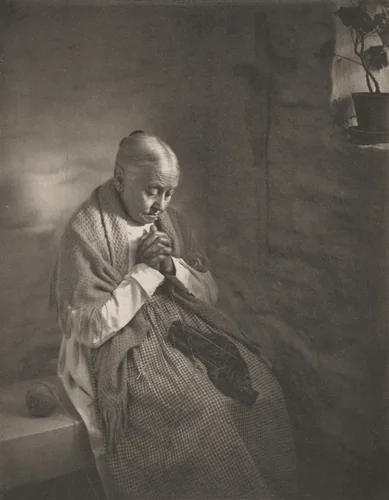
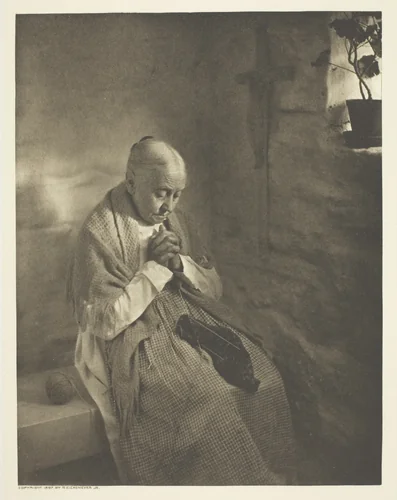
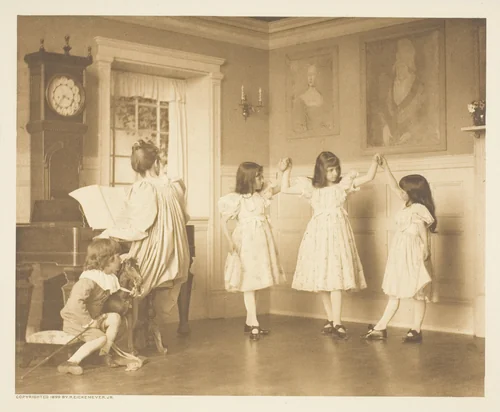
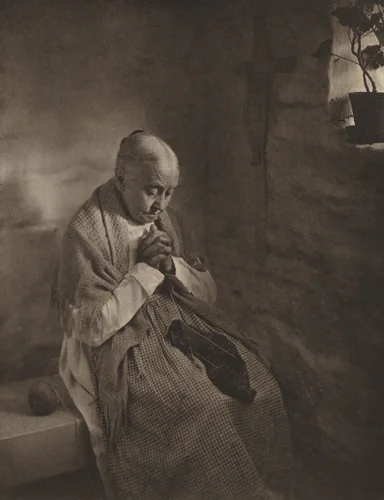
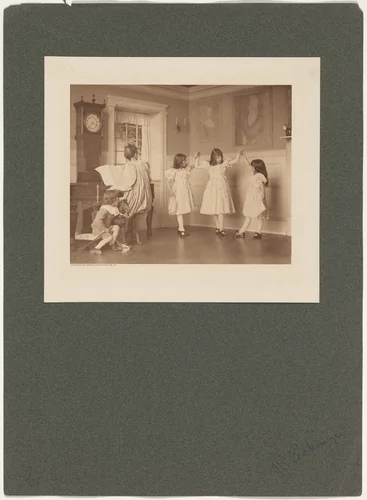
His documented works include subjects like The Vesper Bell and The Dance, both of which were chosen for inclusion in important contemporary portfolios. For instance, Vesper Bells was featured as No. 6 in the 1899 portfolio American Pictorial Photography, Series I, produced in a limited edition of 150. Similarly, The Dance appeared as No. 7 in the subsequent Series II portfolio of 1901. These inclusions place Eickemeyer within the international dialog surrounding Pictorialism, an aesthetic movement that sought to elevate photography to the status of fine art through careful composition, atmospheric effects, and manual manipulation of the printing process.
The enduring interest in Eickemeyer’s work has ensured that pieces such as these remain important references for scholars. Today, examples of his work, including numerous royalty-free images, are increasingly available through the public domain, allowing new generations to appreciate his brief but concentrated output. Given his exacting background as an engineer and mathematician, it is perhaps fitting that Eickemeyer’s transition into art resulted in precise, museum-quality images meticulously published in limited editions.
Source: Wikipedia · CC BY-SA 4.0