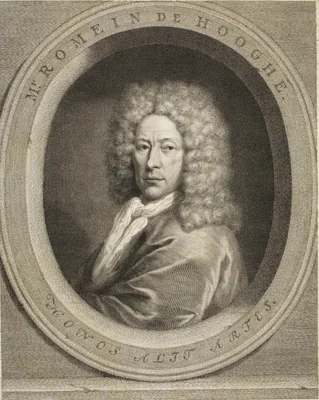
Romeyn de Hooghe
Romeyn de Hooghe (active c. 1645-1660) stands as a dynamic and controversial figure of the Late Dutch Baroque, known for his extraordinary output across painting, sculpture, engraving, and caricature. Though fluent in traditional disciplines, including early Romeyn de Hooghe paintings, his historical significance lies in his graphic work, where he transformed the conventions of the satirical print into an authoritative visual medium. He employed the printing press not merely for reproduction, but as a robust means of mass political and social communication.
De Hooghe’s artistic practice was characterized by technical fluency and narrative density. He utilized etching and engraving to capture the volatile atmosphere of the Netherlands, seamlessly blending journalistic detail with a heightened Baroque sense of drama. Works like Raising of Lazarus with Scenes from the Life of Christ demonstrate his command of complex, large-scale narrative composition, while genre scenes such as Drinkgelag (Drinking Bout) reveal his keen eye for social critique and theatrical detail. He was particularly adept at political polemics; the boldly titled No Monarchy, No Popery serves as a direct manifesto rendered through intricate visual allegory. His commitment to historical documentation is also evident in topographical pieces, such as the expansive Gezicht op Lissabon (View of Lisbon).
De Hooghe’s prolific production ensured his rapid dissemination and continued presence in major global institutions, including the Rijksmuseum, the Metropolitan Museum of Art, and the National Gallery of Art. It must be noted that while De Hooghe’s images provide invaluable insight into seventeenth-century life, separating the historical record from his specific, often biting, political commentary remains a fascinating challenge for contemporary viewers.
The robust nature of his original copperplates means that numerous high-quality prints and downloadable artwork derived from the Romeyn de Hooghe prints are now readily available in the public domain. This accessibility ensures that his biting wit and superb draftsmanship remain easily accessible and royalty-free for historical and artistic study.
Source: Wikipedia · CC BY-SA 4.0