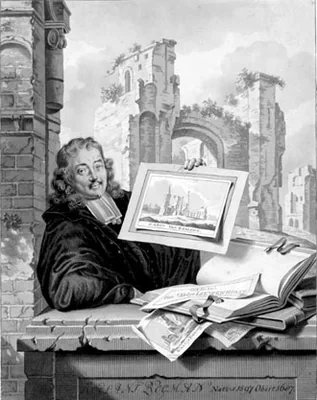
Roelant Roghman
Roelant Roghman stands as an important, if often overlooked, contributor to the prolific artistic output of the Dutch Golden Age. Active primarily between 1627 and 1640, his significance derives from his mastery across multiple mediums; he was recognized as a painter, a deft sketcher, and an accomplished engraver. While records point to a relatively concise body of work, predominantly comprising prints and drawings, the technical skill exhibited in these pieces secured his place in the history of seventeenth-century Dutch draftsmanship. His surviving corpus, currently housed in major institutions including the Rijksmuseum, the Metropolitan Museum of Art, and the Art Institute of Chicago, allows for close study of his compositional techniques.
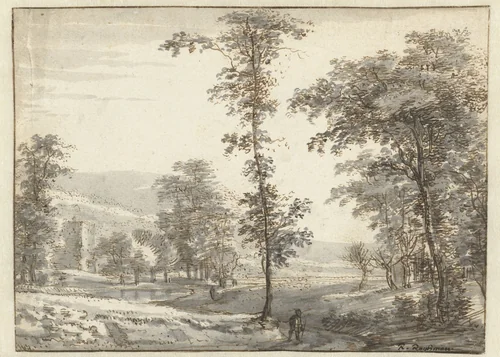
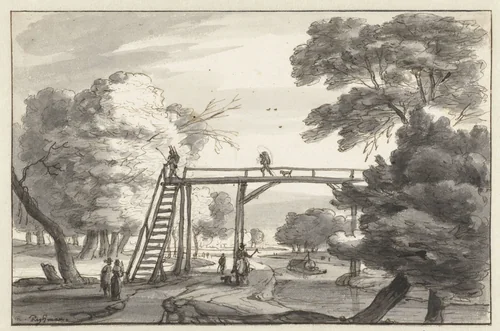
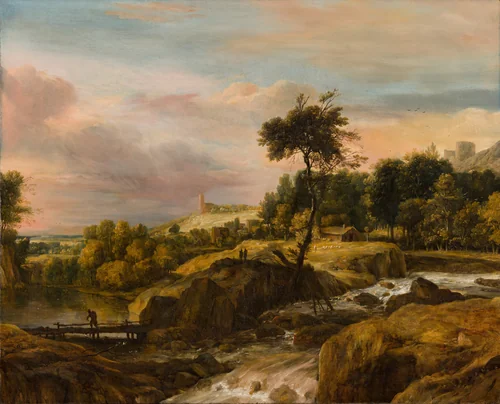
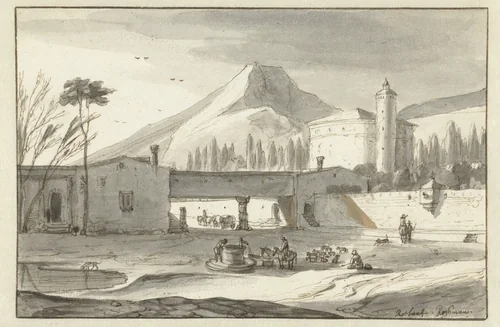
Roghman’s subject matter focused heavily on the topography of the Netherlands, oscillating gracefully between intimate rural scenes and meticulous urban documentation. Works like Hesbeen and Horseman and Attendants at the Edge of a Wood demonstrate a keen observational eye for natural light and the subtle dramas of travel through the countryside. However, his prints also served a significant documentary function. His renderings of specific city locales, such as Gezicht op Dordrecht and the architectural detail captured in Gezicht op de Westerhal en de Westerkerk vanaf de Keizersgracht, provide invaluable historical records. It is perhaps an understated observation that this artist, known for his ability to handle the vast, sprawling natural vistas evident in his generalized Landscape studies, proved equally adept at navigating the rigid geometry of Golden Age urban centers. For those studying historical representations of the Netherlands, high-quality prints derived from his work remain essential resources.
As an engraver, Roghman played a vital role in popularizing landscape motifs far beyond the confines of private painting collections. Engraving allowed for the widespread dissemination of imagery, influencing subsequent generations of artists who utilized the standardized format he helped refine. The existence of these documented works confirms the importance of Roelant Roghman prints in establishing the visual vernacular of the 17th-century Dutch environment. Today, many of his original sketches and prints have entered the public domain, making downloadable artwork widely accessible to researchers and enthusiasts alike, ensuring his focused contribution continues to be appreciated.
Source: Wikipedia · CC BY-SA 4.0