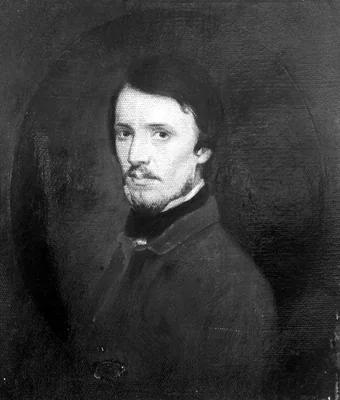
Robert Swain Gifford
Robert Swain Gifford (1840-1905) was an influential American landscape painter and etcher whose focused observation of nature provided a vital bridge between the grand Romanticism of the mid-nineteenth century and the emergent intimacy of fin-de-siècle realism. His significance is underscored by his lasting presence in major institutional holdings, with works actively collected by the Metropolitan Museum of Art, the Art Institute of Chicago, and the National Gallery of Art.
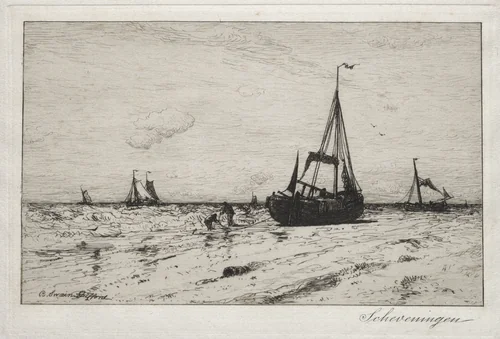
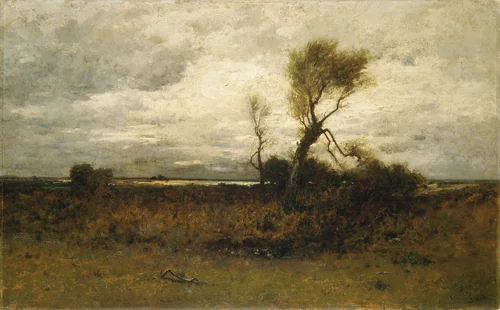
Gifford’s artistic orientation was profoundly shaped by the principles of the French Barbizon school. Abandoning the dramatic, sweeping panoramas favored by many of his domestic contemporaries, he adopted a more restrained approach characterized by muted color palettes, subtle atmospheric effects, and a dedication to rendering nature directly from life. This influence guided his technical output, which included twelve documented prints alongside numerous paintings, active between 1860 and 1886.
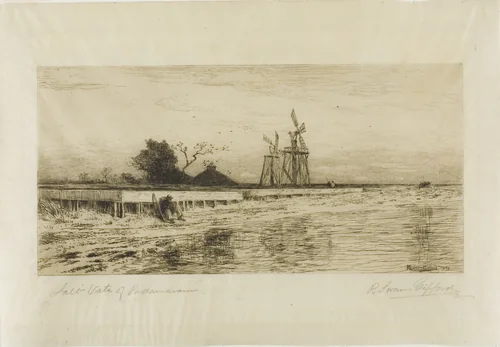
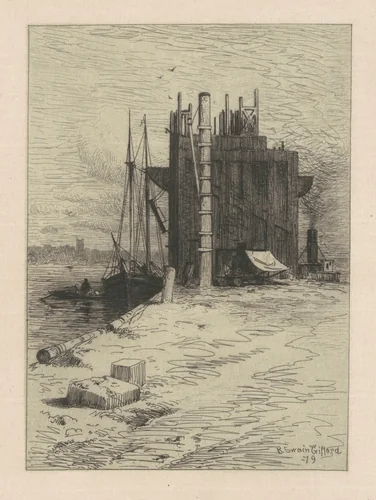
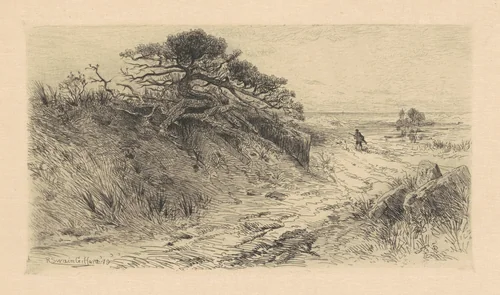
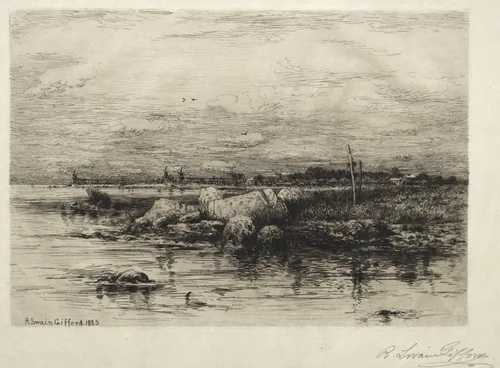
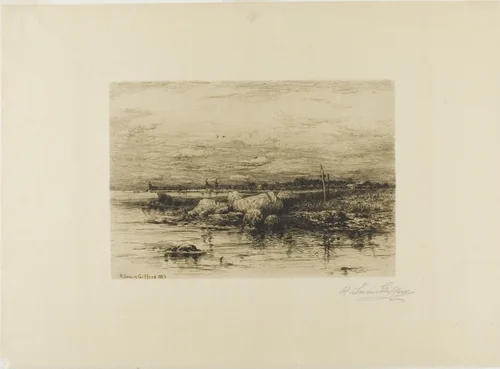
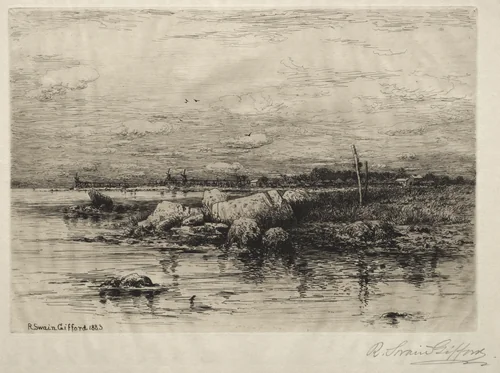
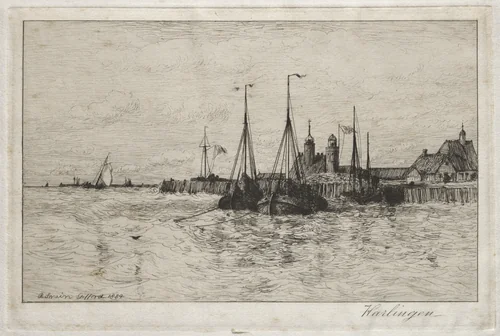
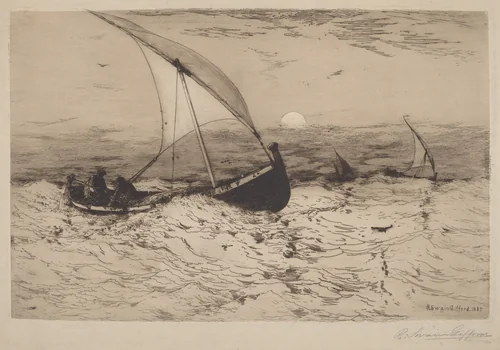
His oeuvre demonstrates a particular affinity for coastal and maritime subjects, reflecting the rugged character of New England. In etchings such as Old Trees at Naushon Island and its detailed counterpart Old Trees at Naushon Island [plate 2], Gifford emphasizes the textures of weathered wood and shifting light rather than idealized scenery. Further distinction is found in his treatment of industrial and utilitarian architecture. Works like Salt Vats of Padanaram and Coal Pockets at New Bedford transform structures essential to American commerce into compelling subjects for contemplation. One might observe that Gifford was among the few artists of his generation willing to bestow genuine artistic dignity upon the infrastructure of the working shore.
Gifford’s standing was formalized through his membership in the progressive Society of American Artists, an organization dedicated to advancing modern artistic thought in the United States. His commitment to precise execution and atmospheric realism ensured that his work remained historically relevant. Today, the enduring quality of his draftsmanship is accessible to a global audience; many of his images, including numerous high-quality prints and Robert Swain Gifford paintings, have entered the public domain, offering researchers and collectors valuable access to this pivotal chapter in American landscape art.
Source: Wikipedia · CC BY-SA 4.0
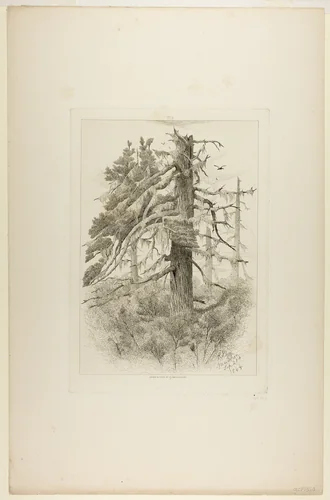
![Old Trees at Naushon Island [plate 2] by Robert Swain Gifford, print, 1865](https://img.artbee.org/857a2a67-1f58-4f41-9b95-2564bb7b0d5d/small.webp)
![Near the Coast [large plate] by Robert Swain Gifford, print, 1886](https://img.artbee.org/abc1c855-8a2c-4e1b-a1cc-752e25cb1493/small.webp)
![Near the Coast [small plate] by Robert Swain Gifford, portfolio, 1886](https://img.artbee.org/574a90fe-b134-45e9-ba79-c744cde56148/small.webp)