Robert Smirke
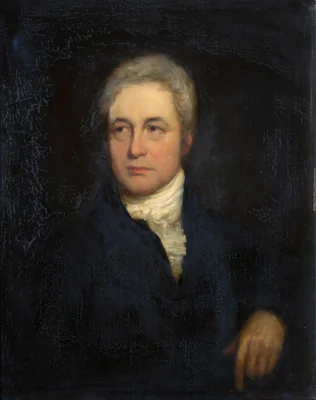
Robert Smirke (1753-1845), the celebrated English painter, established a vital niche in late Georgian and early Regency art, focusing primarily on large-scale history paintings, sophisticated illustrative scenes, and allegorical drawings. It is essential to distinguish the father's prolific artistic career from that of his equally famous son, also named Robert Smirke, the highly influential architect responsible for the design of the British Museum.
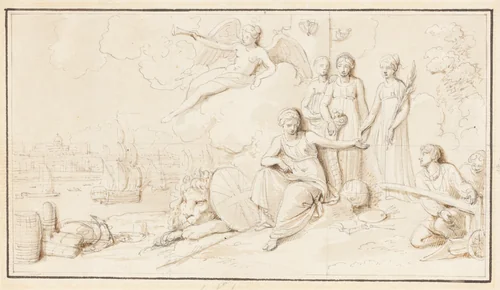
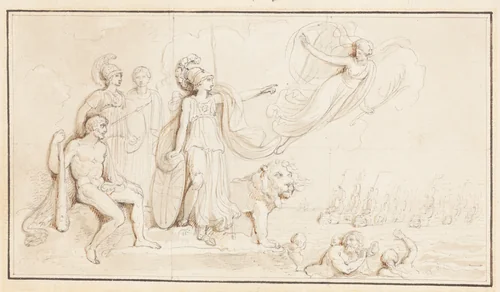
Smirke the elder’s body of work, active from the 1750s through the 1840s, often served an overtly patriotic or commemorative function, reflective of Britain's rapid expansion during the era of the Napoleonic Wars. His meticulous drawings are masterclasses in political symbolism, leveraging neoclassical aesthetics to celebrate national identity and commerce. Two powerful examples of this approach are the companion pieces, An Allegory of Britain's Mercantile Power and An Allegory of Britain's Naval Might. These works utilize complex, layered iconography, framing the nation's burgeoning global dominance in trade and military strength, functioning almost as visual policy statements for the public sphere.
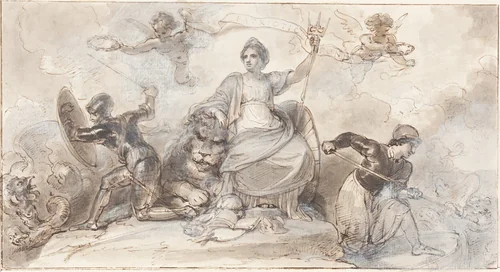
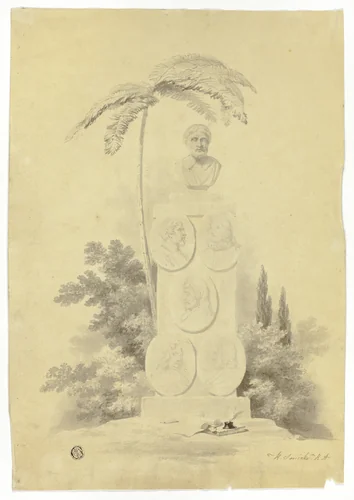
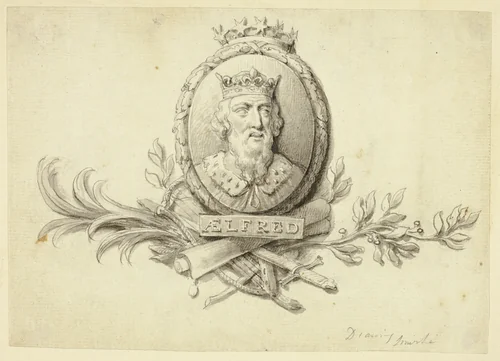
Beyond overtly national allegories, Smirke contributed significantly to public and commemorative art commissions. His design for the Patriotic Fund underscores his involvement in civic campaigns supporting wartime efforts, while sophisticated designs like Monument with Palm Tree and Mementos suggest an aptitude for complex architectural and funerary memorial designs. His detailed preparatory sketches, such as the Design for Medallion of King Alfred, reveal an impressive academic rigor, showcasing the commitment to historical accuracy and clarity of composition demanded by the institutional style of the period.
It speaks volumes about the longevity and adaptability of Smirke’s talent that his active professional life spanned nine decades, beginning well before the American Revolution and concluding only three years before the start of the California Gold Rush. Today, Smirke’s artistic legacy is preserved in premier institutions, including the National Gallery of Art and the Art Institute of Chicago, where the few extant Robert Smirke paintings and drawings are maintained as museum-quality documents of late 18th-century graphic traditions. The increasing availability of his work within the public domain, often reproduced as high-quality prints and free art prints, ensures that his distinct contribution to British visual culture remains accessible to scholars and enthusiasts worldwide.
Source: Wikipedia · CC BY-SA 4.0