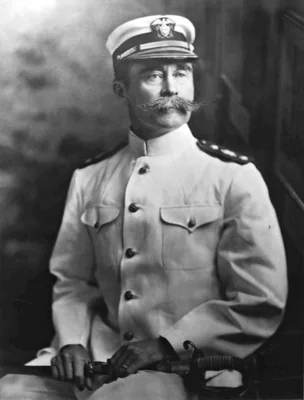
Robert E. Peary
Robert Edwin Peary was an American naval officer and ambitious Arctic explorer whose decades-long pursuit of the geographic North Pole, beginning in the late nineteenth century, yielded a crucial photographic record of a rapidly changing environment. While his expeditions were fundamentally focused on mapping and military exploration, the few surviving photographs from 1893, including striking, minimalist views of Icebergs and his expedition vessels, such as Peary's Ship, position him as a pioneering documentarian of one of the planet’s most inaccessible regions.
Operating with rudimentary equipment and bulky glass plates in sub-zero temperatures, Peary's photographic output is characterized by its stark factual clarity, yet achieves an unsettling beauty. These images transcend simple documentation, capturing the overwhelming scale and silence of the glacial landscape. They offer a fascinating visual counterpoint to the dramatic and often contentious narratives of exploration they accompanied. His intimate Self-Portrait, taken during one of the most demanding phases of his journey, provides a rare, unflinching look at the physical toll of monumental ambition.
Peary's historical legacy remains complex. He was long credited as the discoverer of the geographic North Pole in April 1909, having led the first expedition to formally claim this achievement, although later analysis has suggested it is unlikely he reached the precise location. Regardless of the topographical accuracy of his final claim, the veracity of his visual achievements is indisputable. The visual records he created are highly valued today; this invaluable historical material is now widely available as high-quality prints for academic and public study. That a naval commander managed to produce museum-quality documentation while simultaneously attempting to conquer the world’s harshest terrain is, perhaps, the most intriguing detail of his storied career. Today, these early Robert E. Peary prints remain key holdings in collections like the Metropolitan Museum of Art.
Source: Wikipedia · CC BY-SA 4.0
![[Icebergs] by Robert E. Peary, photograph, 1893-1895](https://img.artbee.org/746a6d7b-9a38-492c-adf7-f0aeaefba4f7/small.webp)
![[Peary's Ship] by Robert E. Peary, photograph, 1893-1895](https://img.artbee.org/4ba16229-358b-486c-bfba-7b34ee60abb6/small.webp)
![[Peary's Ship] by Robert E. Peary, photograph, 1893-1895](https://img.artbee.org/8b37896f-5f05-4525-9483-0947b404ddcc/small.webp)
![[Peary's Ship] by Robert E. Peary, photograph, 1893-1895](https://img.artbee.org/76c5e163-0109-42d5-8695-463a054ac231/small.webp)
![[Self-Portrait] by Robert E. Peary, photograph, 1893-1895](https://img.artbee.org/6e4add85-436b-4f9a-b035-07b55e62e5f3/small.webp)