Robert Adam
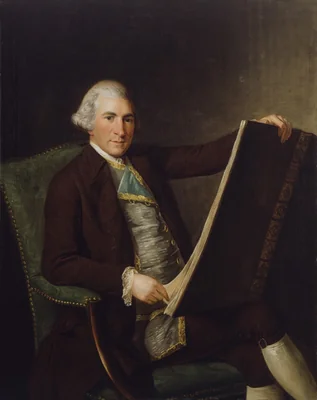
Robert Adam (1728-1792) stands as one of the pre-eminent figures of eighteenth-century British Neoclassicism, profoundly influencing architecture, interior spaces, and decorative arts across the British Isles. Born into a celebrated architectural dynasty, he was the son of William Adam, then Scotland's foremost architect, and received his initial training directly under his father. This foundational experience in structural design and large-scale project management set the stage for a career defined by meticulous classical refinement and innovative applications of ancient motifs.
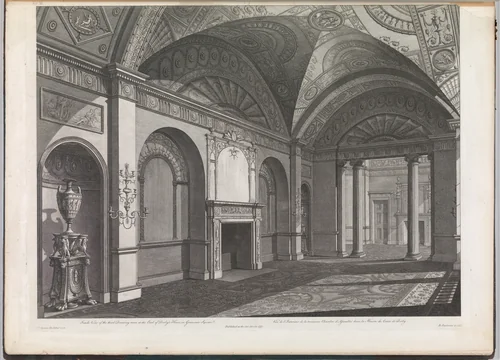
Adam’s active period, roughly 1740-1764 based on extant drawings, shows a remarkable versatility. Upon the death of his father, he and his older brother, John, inherited and expanded the family enterprise. While the firm handled lucrative commissions, including vital work for the Board of Ordnance, Robert Adam concurrently developed his distinct design language. His detailed draftsmanship is particularly evident in studies for interiors, such as the several precise architectural drawings now held in the Metropolitan Museum of Art.
These pieces, including a Design for a Ceiling and a Design for a Panel, exemplify his commitment to harmonizing classical proportion with refined ornamentation. His embrace of newly excavated classical sources is visible in works like the Design for a Chimney Piece in the Pompeian Style, showcasing the light, decorative treatment of Roman antiquity that became his signature style. Beyond architectural blueprints, Adam also demonstrated skill in landscape drawing, evidenced by studies such as the evocative pair, Ancient buildings next to water in the woods (recto); A variation of the same landscape in reverse (verso).
That Adam balanced monumental state projects with highly specific designs for domestic fittings, often supervising the entire decorative ensemble from carpet to clock, speaks volumes to his commercial acumen and artistic control. His prolific output, documented through hundreds of surviving drawings, means that many of these historically significant studies are now in the public domain. These designs are frequently used to create museum-quality reproductions, allowing institutions to offer high-quality prints of Robert Adam prints and studies of his influential work globally.
Source: Wikipedia · CC BY-SA 4.0