René Le Bègue
René Louis Paul Le Bègue (active 1902-1906) occupies a significant, if tightly constrained, position within early 20th-century Pictorialist photography. Though his public artistic output spanned barely four years, his works secured immediate critical attention and established him as a master of atmospheric subtlety. Key prints are held today in prestigious collections, including the Metropolitan Museum of Art and the Cleveland Museum of Art, affirming the lasting impact of his brief but intensely focused career.
Le Bègue’s commitment to the medium coincided with the height of the international photographic secession movement. He mastered the defining characteristics of Pictorialism: the careful manipulation of light, the soft focus intended to evoke painterly qualities, and the emphasis on symbolic mood over sharp documentary realism. His inclusion in Camera Work, the influential journal edited by Alfred Stieglitz, confirms his status among the era's elite international photographers. Specifically, his work featured in Camera Work: Number 16 (October 1906), cementing his reputation shortly before his photographic activity ceased.
His contributions consistently explored classical forms and complex tonalities. Studies such as the formal Académie and the abstracting [Study in Orange] exemplify the French artistic tradition of the nude study, prioritizing structure, light, and aesthetic distance. These refined compositions showcase the technical precision necessary to achieve Pictorialism’s complex printing effects, particularly when dealing with the delicate relationship between figure and environment.
Interestingly, Le Bègue maintained a fascinating public duality. His historical record identifies him primarily not as an artist, but as a noted French racing driver. This commitment to two such divergent fields—navigating the exacting demands of photographic aestheticism while mastering the volatile power of early automotive engineering—offers a curious subtext to his visual work. Perhaps the intense focus required at speed informed the remarkable concentration evident in his short artistic burst.
Despite the brevity of his active years, the highly refined quality of René Le Bègue prints secured his legacy. His small but essential body of work remains a key touchpoint for studying the evolution of photographic aestheticism at the beginning of the century. As these historical documents age, many are now available for study, often transitioning into the public domain, allowing enthusiasts to seek museum-quality reproductions or high-quality prints for academic exploration.
Source: Wikipedia · CC BY-SA 4.0
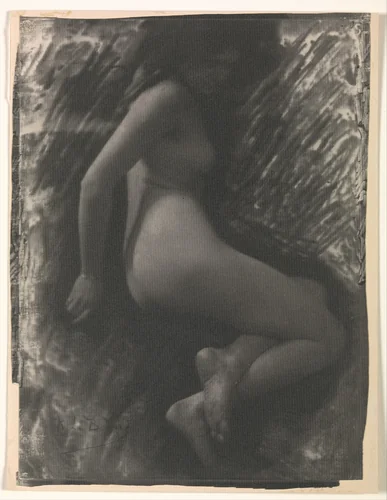
![[Study in Orange] by René Le Bègue, photograph, 1903](https://img.artbee.org/8c9755ce-f495-4199-872a-4d38c60e39e7/small.webp)
![[Study in Orange] by René Le Bègue, photograph, 1904](https://img.artbee.org/0557a5cd-bf4c-4d35-9796-b4658ad39a3b/small.webp)
![Camera Work: Study [Nude] by René Le Bègue, book, 1906](https://img.artbee.org/0c66df4c-d237-4c16-ba3d-12c885f2c7a8/small.webp)