Ray Holden
Ray Holden is recognized for his essential, if concise, contributions to the seminal Index of American Design (IAD), a massive initiative launched by the Federal Art Project during the New Deal era. Active primarily between 1935 and 1936, Holden was tasked with meticulously documenting American material culture, focusing on recording the craftsmanship of historic objects that were vulnerable to decay or dispersion. His fifteen documented entries stand as critical visual records from this period.
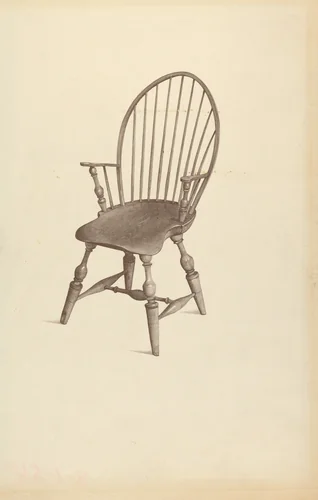
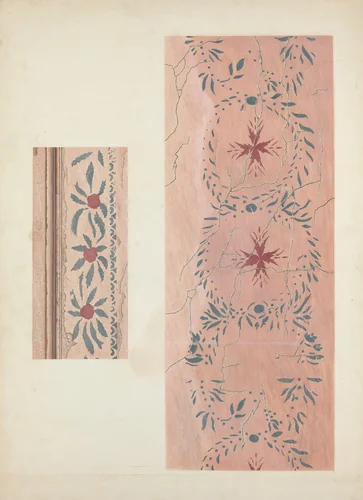
Holden specialized in the disciplined documentation of Shaker design, an aesthetic tradition defined by its functional simplicity and structural integrity. His portfolio from the IAD emphasizes schematic precision, illustrating the architectural ingenuity hidden within common objects. Holden’s drawings function less as artistic interpretations and more as archival evidence, capturing complex joinery and detailed construction methods with rigorous accuracy. Key pieces include his studies of utilitarian objects such as Wallpaper designs and dimensional renderings of storage solutions like the Shaker Chest and the substantial Shaker Chest of Drawers.
Perhaps the most telling example of his focus on technical detail is the rendering of Shaker Chair Finials and Ball & Socket Foot, which isolates and celebrates the elegant mechanics of the furniture rather than the finished piece itself. The IAD demanded an almost bureaucratic commitment to line work and faithful color accuracy, prioritizing utility over personal expression. It is a subtle observation that Holden’s visual chronicling flourished during this intense two-year period, resulting in records that remain museum-quality resources today.
The lasting significance of Holden’s work is confirmed by its preservation in the permanent collection of the National Gallery of Art in Washington D.C. As creations commissioned by the U.S. government, Ray Holden’s images are broadly available in the public domain. This accessibility allows researchers and enthusiasts to utilize the detailed documentation of American craftsmanship as high-quality prints. These royalty-free resources ensure that his focused work remains an important touchstone for the study of decorative arts history.
Source: Wikipedia · CC BY-SA 4.0