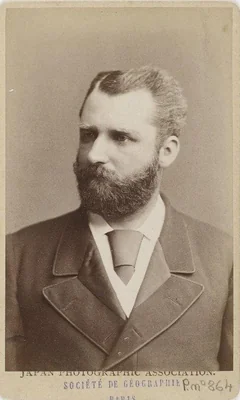
Raimund von Stillfried
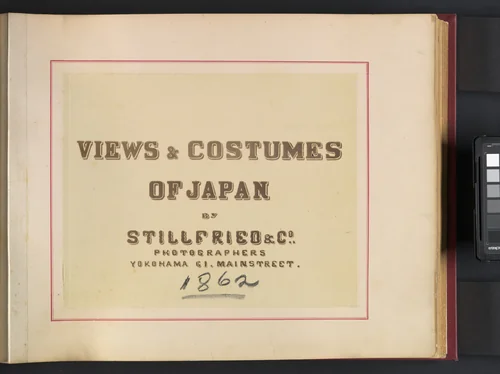
Raimund von Stillfried (Baron Raimund von Stillfried-Rathenitz) occupies a unique and pivotal position in the early history of photography in Japan. Transitioning from an Austrian military officer to an esteemed professional photographer in the early 1870s, Stillfried focused his lens on a society undergoing monumental, often volatile, transformation. His active period precisely coincided with the collapse of the Tokugawa shogunate and the onset of the Meiji Restoration, granting him the singular opportunity to capture a transitional world on the cusp of modernization.
Operating primarily from a studio in Yokohama, Stillfried mastered the technically challenging wet-plate collodion process, yielding striking albumen prints. His output is characterized by a high degree of technical precision and often includes meticulous hand-coloring, elevating the documentary image toward the realm of fine art. Unlike contemporaries who focused purely on scenery, Stillfried developed a recognizable and rigorous studio practice specializing in staged genre scenes and portraits that served both as ethnographic records and commercial products.
Works such as Brouette, Femme de Canton, and the detailed portraits like Fille de Lantcheou demonstrate his commitment to nuanced composition and high-quality prints that bridged documentation and aesthetic study. It is perhaps one of history’s finer ironies that a European baron proved to be such a compelling visual chronicler of an island nation newly emerging from centuries of carefully maintained isolation.
Stillfried’s body of work holds undeniable documentary value, providing historians with irreplaceable visual records of customs, professions, and architecture that were rapidly being altered by political and economic forces. Collected internationally by institutions including the Metropolitan Museum of Art, the significance of Raimund von Stillfried prints is widely acknowledged. While appreciated for their museum-quality detail and composition, many of his key photographic plates have subsequently entered the public domain, ensuring that this crucial visual record of 19th-century Japan remains widely accessible as downloadable artwork for study and appreciation.
Source: Wikipedia · CC BY-SA 4.0
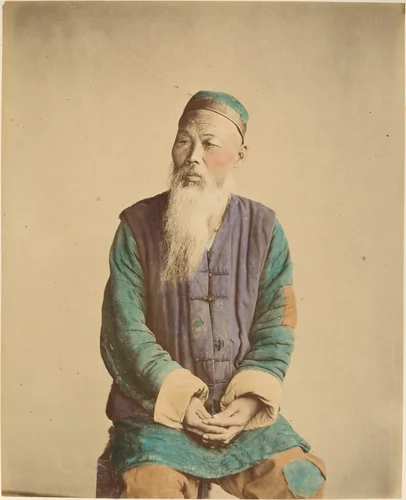
![[Chinese Gentleman] by Raimund von Stillfried, photograph, 1870-1879](https://img.artbee.org/8533b379-032e-4905-ade4-a6593b44045d/small.webp)
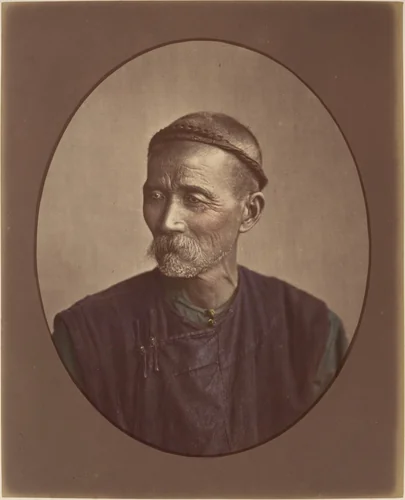
![[Chinese Man Wearing Hat] by Raimund von Stillfried, photograph, 1870-1879](https://img.artbee.org/ab1686f5-afbb-4b96-86d5-41d66f9c1d6a/small.webp)
![[Chinese Man] by Raimund von Stillfried, photograph, 1870-1879](https://img.artbee.org/1720bf4c-0fa4-4abc-bfb3-5e2606e80f57/small.webp)
![[Chinese Woman Sitting with Basket] by Raimund von Stillfried, photograph, 1870-1879](https://img.artbee.org/98c82735-5b00-4c3e-95c1-bc14ee47576a/small.webp)
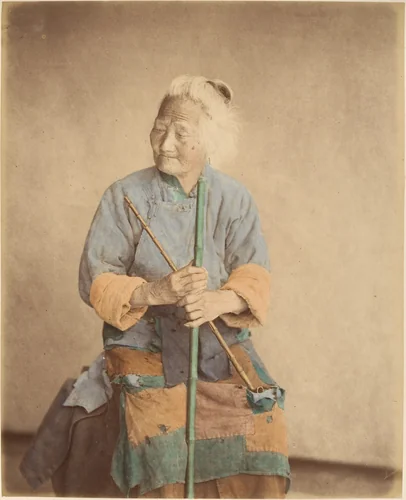
![[Portrait of an Old Chinese Woman] by Raimund von Stillfried, photograph, 1870-1879](https://img.artbee.org/0d5c5808-fbcb-40a0-b60b-f6efb262cca6/small.webp)
![[Seated Chinese Woman with Fan] by Raimund von Stillfried, photograph, 1870-1879](https://img.artbee.org/fa896d7c-675b-4937-8865-3cde95c7eb07/small.webp)
![[Two Chinese Men in Matching Traditional Dress] by Raimund von Stillfried, photograph, 1870-1879](https://img.artbee.org/993b7c87-e85f-4a70-81a0-de7302477e7c/small.webp)
![[Woman from Canton] by Raimund von Stillfried, photograph, 1870-1879](https://img.artbee.org/d6928ea1-eeae-4c9f-a20a-cf6cf1c5f754/small.webp)
![[Young Chinese Gentleman] by Raimund von Stillfried, photograph, 1870-1879](https://img.artbee.org/462425d1-c6c8-4174-8201-893329308b15/small.webp)
![[Studio Portrait of a Japanese Man in Western Clothing] by Raimund von Stillfried, photograph, 1880-1889](https://img.artbee.org/9dd940d7-016c-4866-8465-579b3d2e1576/small.webp)