Rackstraw Downes
Rackstraw Downes (b. 1939) is a British-born painter and author recognized for expanding the vocabulary of contemporary Realism. Distinguished by their painstaking fidelity and panoramic scope, Rackstraw Downes paintings fuse meticulous technical execution with an unflinching engagement with infrastructure and environmental change. Unlike many contemporary artists who utilize photography as an intermediate step, Downes insists on rendering his subjects exclusively from direct observation, often spending months completing a single canvas outdoors. This commitment to the plein-air tradition provides the foundation for his intensely observed realism, documenting the fleeting realities of industry and urban expansion.
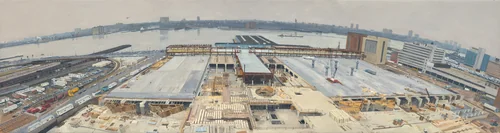
Downes’s most striking formal innovation lies in his treatment of perspective and composition. He consistently employs elongated, horizontal formats that challenge standard visual conventions, often requiring the viewer’s eye to traverse a complex, multiple-perspective field of vision. He meticulously integrates several vanishing points into compositions, allowing him to capture the true breadth of a sweeping vista-for example, the layered urban sprawl visible in Bird's Eye View of the New York Convention Center under Construction or the detailed industrial operations seen in the preparatory work, Study for "U.S. Scrap Metal Gets Shipped for Reprocessing in Southeast Asia, Jersey City" [recto]. The result is a highly kinetic, almost hyper-real space where the viewer is invited to physically move through the scene, acknowledging the inherent difficulty of truly representing a vast three-dimensional space on a flat plane.
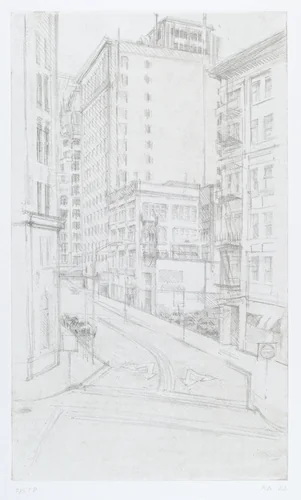
Downes shifts the focus of painting away from idealized natural settings toward the working reality of the modern world: construction sites, junkyards, air travel corridors, and the historic urban views exemplified by works like Latham Square. His careful documentation elevates these often-overlooked spaces, documenting the specific, often messy, processes of contemporary life with a quiet formal elegance. A subtle but defining element of his practice is his rigorous intellect; his critical writing frequently mirrors the observational intensity of his visual works.
His stature is affirmed by his representation in major institutional holdings, including the National Gallery of Art. While a growing body of his drawings and preparatory studies are becoming available as high-quality prints through public domain collections, his original works, whether drawings or complex oil paintings, reward close study, cementing his reputation as a master of observational precision.
Source: Wikipedia · CC BY-SA 4.0
![Study for "U.S. Scrap Metal Gets Shipped for Reprocessing in Southeast Asia, Jersey City" [recto] by Rackstraw Downes, drawing, 1994](https://img.artbee.org/f4de1d6e-da28-458f-abd7-c3d32fb57595/small.webp)