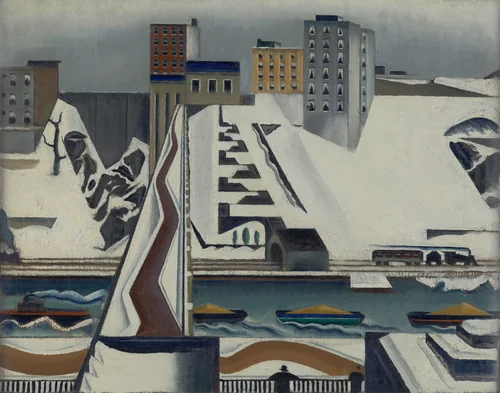
Preston Dickinson
William Preston Dickinson (1885-1930) stands as a foundational, though often underappreciated, figure in American modern art. He is chiefly recognized for establishing the visual grammar of Precisionism, a movement that sought to reconcile the lessons of European Modernist abstraction, specifically Synthetic Cubism and Futurism, with the sharp, clean-edged reality of the American industrial landscape.
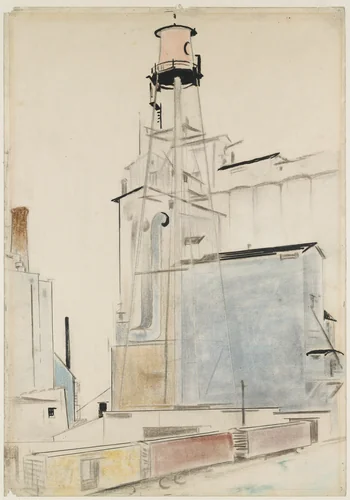
Dickinson’s brief but remarkably impactful active period spanned the 1920s, a decade when American artists grappled with portraying a rapidly mechanized nation. He moved away from earlier exploratory compositions to focus intensely on the geometric severity of machinery and architecture. Works such as Grain Elevators, Omaha and the dynamic study Harlem River capture the stark beauty and colossal scale of nascent American infrastructure, depicting smoke stacks, steel girders, and massive silos not as environmental blemishes, but as monumental forms demanding rigorous formal investigation.
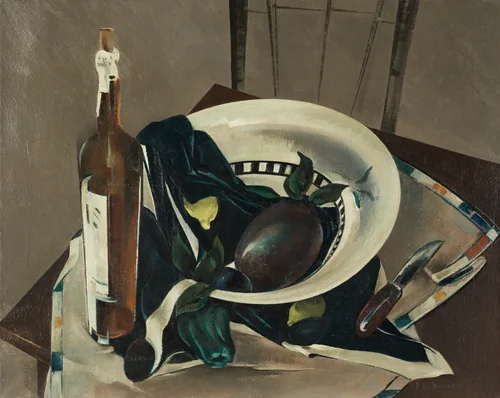
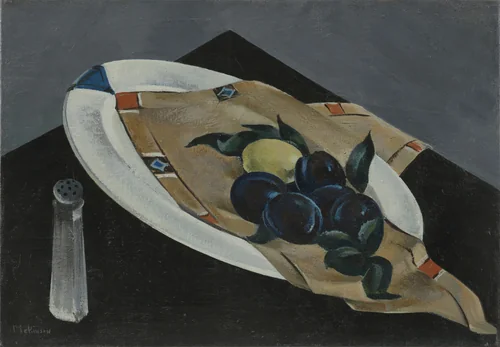
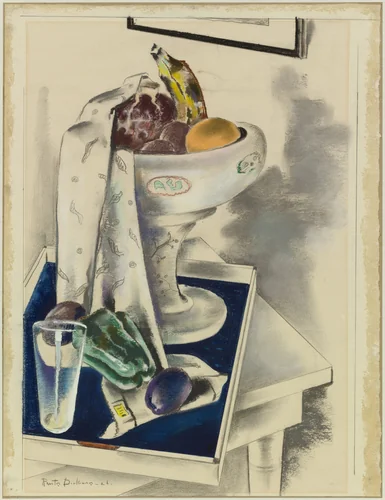
His canvases are characterized by meticulous, almost anonymous rendering, simplified color palettes that often lean toward cool grays and earthy ochres, and a smooth application of paint that eradicated any trace of the artist’s visible hand. This commitment to structural clarity defined the Precisionist approach. Dickinson’s output, however, also demonstrates extraordinary formal versatility, seen equally in the powerful geometry of his industrial scenes and the intimate composition of a work like Plums on a Plate, confirming his mastery across disparate subjects.
Dickinson’s early death in 1930 curtailed a promising trajectory, yet his influence secured the legitimacy of industrial subjects in American modernism. Today, Preston Dickinson paintings are held in major institutions, including the Museum of Modern Art and the Cleveland Museum of Art, testament to his historical significance. For scholars and collectors seeking access to early American modernism, many of his key works, having entered the public domain, are now available as high-quality prints and downloadable artwork.
Source: Wikipedia · CC BY-SA 4.0