Pietro Rotari
Pietro Rotari (1707-1760) occupies a notable position among the skilled portraitists active during the late Baroque era. Born in Verona, Rotari developed a career trajectory that was unusually peripatetic, driven by the intense demand for his elegant and perceptive style among Europe’s aristocratic elite. His geographical mobility was expansive, moving across central Europe before culminating in Saint Petersburg, where he settled and ultimately died while painting for the Russian imperial court.
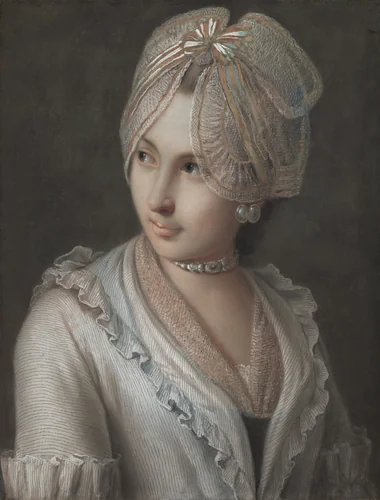
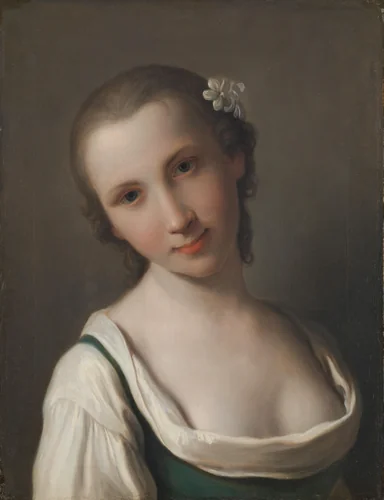
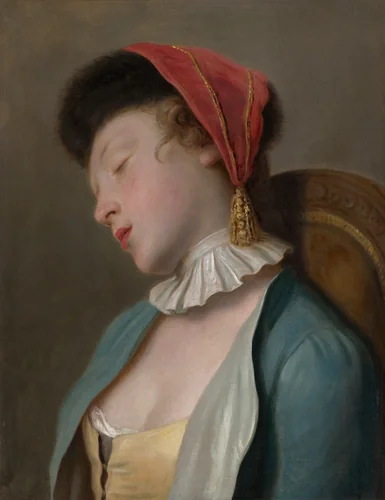
Rotari’s artistic output was highly specialized, focusing almost exclusively on intimate portraiture, particularly of women. He achieved a remarkable mastery of technique, rendering subjects with a compelling combination of technical realism and idealized beauty. These characteristics are clearly evident in works such as An Elegant Young Lady with a Lace Cap, where the delicate rendering of lace and fabric contrasts effectively with the sitter’s forthright gaze. Unlike many of his peers, who dedicated significant energy to vast historical or religious narratives, Rotari found his niche in documenting the grace and refinement of court life. His specialized repertoire, often confined to the royal families and high-ranking court ladies he served, made him a sought-after painter across various capitals. The sensitivity and psychological insight captured in drawings and paintings like A Girl with a Flower in Her Hair suggest a deliberate intention to elevate the private, smaller portrait to a level typically reserved for grand public depictions.
The final, decisive period of Rotari’s career unfolded following his arrival in Russia, where he served Empress Elizabeth Petrovna and later Catherine the Great. It is intriguing to note that his presence marked him as an important cultural conduit, effectively introducing the refined Venetian aesthetic directly into the developing Russian art scene. Though much of his oeuvre remained initially within private royal collections, today institutions such as the National Gallery of Art and the Rijksmuseum safeguard key examples of Pietro Rotari paintings and prints. For researchers and enthusiasts worldwide, many of these museum-quality works are now secured in the public domain and widely available as high-quality prints, ensuring that the legacy of this skilled and specialized portraitist continues to be studied and admired.
Source: Wikipedia · CC BY-SA 4.0