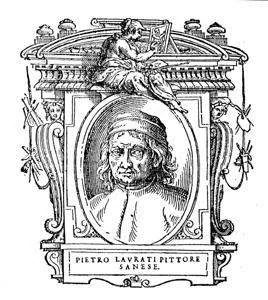
Pietro Lorenzetti
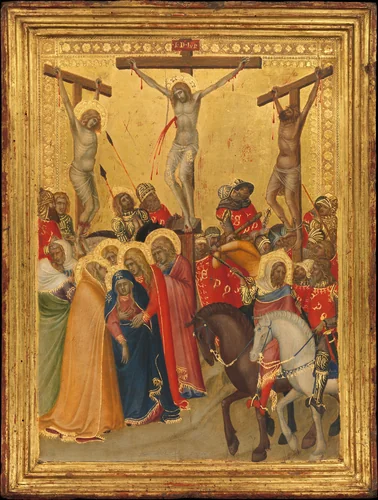
Pietro Lorenzetti, or Pietro Laurati, ranks among the most critically important Italian painters of the early 14th century. Active from approximately 1306 until 1345, he and his younger brother, Ambrogio, collectively initiated a profound shift in Sienese painting. Their work moved decisively away from the strictly codified devotional imagery inherited from the Byzantine tradition, introducing a sense of pictorial naturalism that radically advanced the expressive capacity of late medieval art.
Lorenzetti’s singular achievement lies in his pioneering efforts regarding dimensionality and spatial arrangement. While the visual language of his time still favored hierarchical flatness, Pietro conducted serious and sustained experiments with creating coherent three-dimensional space. His method of structuring figures within an environment that recedes believably and dynamically, evident in surviving works such as the triptych Madonna and Child with the Blessing Christ, and Saints Mary Magdalene and Catherine of Alexandria with Angels, represents a crucial step toward pictorial realism. These investigations into volume and perspective, which anticipate the illusionistic concerns of the next century, position the Lorenzetti brothers as direct precursors to the innovators of the Italian Renaissance.
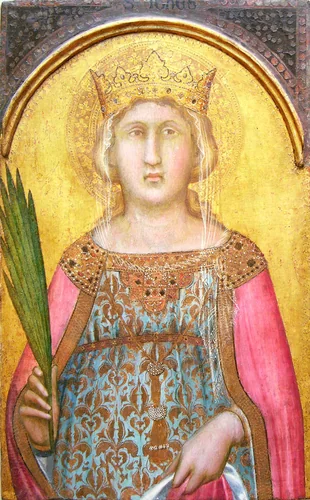
The artist’s influence derived not just from technical innovation but also from an unprecedented psychological depth. His figures, such as those seen in Saint Catherine of Alexandria, display nuanced emotional connections, suggesting a concern for inner life previously uncommon in panel painting. Pietro’s career flourished during a period of intense artistic competition and patronage in Siena. It is sometimes delightfully difficult to distinguish the hands of the two brothers in early pieces, suggesting a close, perhaps overly familiar, working relationship that fueled their mutual commitment to technical advancement.
Although records confirm activity late into the 1340s, the authenticated works, including the core of Pietro Lorenzetti paintings created between 1337 and 1340, confirm his status as a master colorist and compositional genius. Today, many of his most important panels reside in the collections of international institutions, including the Metropolitan Museum of Art and the National Gallery of Art. The historic and artistic weight of this foundational figure ensures that high-quality prints and reproductions are perpetually in demand. Fortunately, many of these museum-quality works are now considered part of the public domain, offering broad access to these foundational pieces of early Italian art.
Source: Wikipedia · CC BY-SA 4.0
![Madonna and Child with the Blessing Christ, and Saints Mary Magdalene and Catherine of Alexandria with Angels [entire triptych] by Pietro Lorenzetti, painting, 1340](https://img.artbee.org/eb71ec09-3c5d-4751-b1d4-76c2415550da/small.webp)
![Madonna and Child, with the Blessing Christ [middle panel] by Pietro Lorenzetti, painting, 1340](https://img.artbee.org/b8c03513-656f-4bfb-a69a-524a2ed3f658/small.webp)
![Saint Catherine of Alexandria, with an Angel [right panel] by Pietro Lorenzetti, painting, 1340](https://img.artbee.org/a2efc07e-f9e7-4c4f-bc5a-3a59cf169380/small.webp)
![Saint Mary Magdalene, with an Angel [left panel] by Pietro Lorenzetti, painting, 1340](https://img.artbee.org/148d2ebf-51dd-4a33-9673-65b6b80e0970/small.webp)