Pieter Perret
Pieter Perret, a Flemish engraver active during a remarkably concentrated period between 1579 and 1583, stands as a crucial vector in the late sixteenth-century transmission of Renaissance aesthetics from the North and Italy to the Spanish court. Following foundational training in Antwerp, where he mastered the rigorous traditions of Northern European printmaking, Perret traveled to Rome. This dual exposure provided the essential synthesis necessary for his career, blending Flemish technical precision with the monumental scope of contemporary Italian art.
His professional life reached its apex when he entered the service of Philip II of Spain in Madrid. Perret’s arrival marks a defining moment, as he is widely credited with introducing the sophisticated Flemish printmaking tradition directly into Spain, thereby renewing and elevating the graphic arts within the Iberian Peninsula. He specialized in large-scale reproductions, architectural views, frontispieces, and portraiture, designed to satisfy the erudite tastes of the Habsburg monarchy.
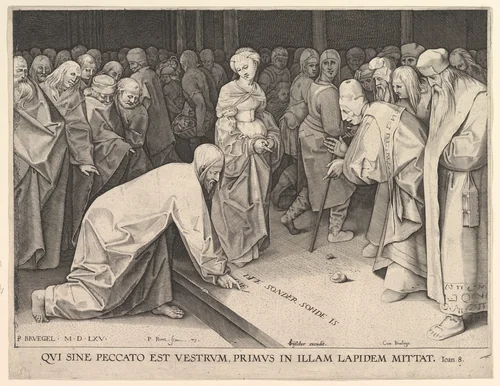
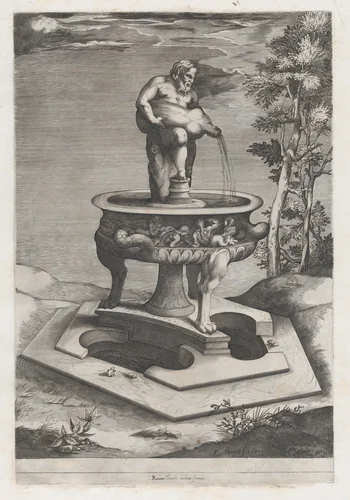
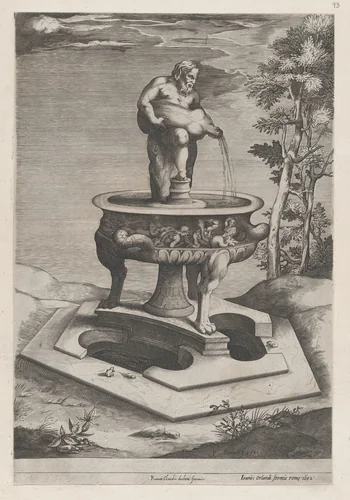
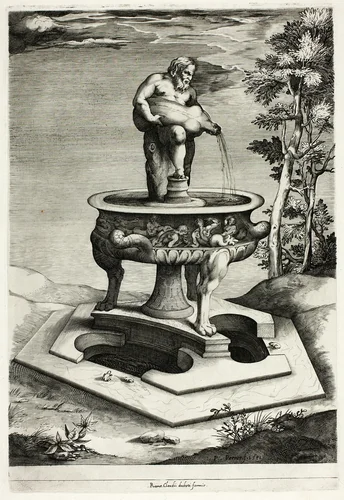
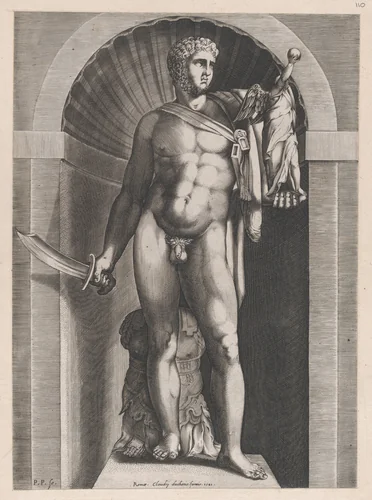
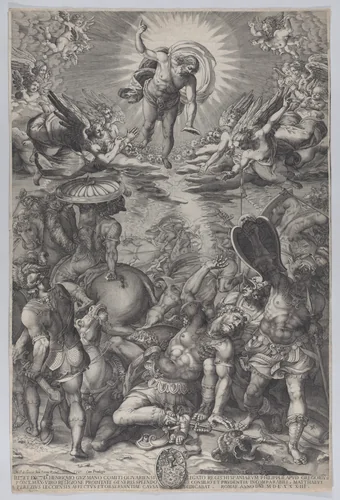
Perret’s documented oeuvre is small, comprising only six known high-quality prints, yet the impact of these works far exceeds their number. His subjects demonstrated considerable range, moving easily between the biblical complexity of Christ and the Woman Taken in Adultery and ambitious classical documentation. His contributions to the monumental collection Speculum Romanae Magnificentiae are particularly important, documenting the grandeur of ancient and contemporary Rome. These included detailed architectural studies such as A Fountain and Basin and the precise recording of the sculptural decoration in Fountain with Silenus in the Garden of the Cesi Palace near Rome. It is a striking historical fact that an artist of such profound influence and technical rigor secured his legacy based on such a highly focused, compressed four-year period of activity.
The enduring quality of Pieter Perret prints ensures their presence in major international institutions, including the Metropolitan Museum of Art and the Art Institute of Chicago. Today, many of these historically vital designs are available as downloadable artwork through public domain collections, confirming the lasting importance of his innovation in the renewal of Spanish graphic art.
Source: Wikipedia · CC BY-SA 4.0